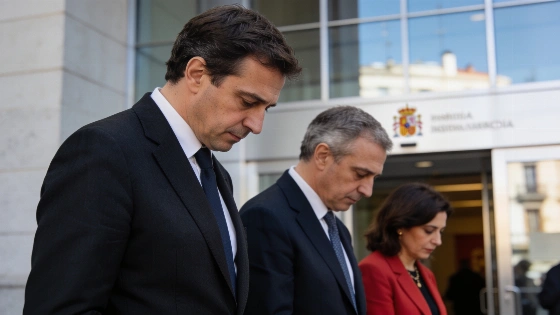
Más Madrid and PSOE held a minute of silence outside the Assembly of Madrid and City Hall after the Partido Popular refused to include a tribute to Maricarmen in either institution’s plenary. Maricarmen, 87, died on 7 October 2026 at Gregorio Marañón Hospital, where she had spent approximately 14 to 15 days, after her eviction from her Retiro home on 23 September.
At 9.45am, Más Madrid and PSOE held a minute of silence in the Assembly’s exterior atrium. The following day, most councillors from the two parties gathered near the Cibeles entrance at around 9am, before the municipal plenary began. The PP kept the tribute outside both official chambers.
EFE reported that Maricarmen had lived in the Retiro home for around 70 to 71 years. The PP said it regretted her death but did not want to take part in what it called the political use of her case for a campaign with vested interests. SER reported that the party viewed the proposed tribute as an attempt at political instrumentalisation. Its position kept the planned minute of silence out of both institutions it governed.
Inside City Hall, Reyes Maroto created her own moment of remembrance. The socialist spokesperson spent one minute of her speech in silence in Maricarmen’s memory and proposed that Madrid organise a tribute. Maroto said the PP had fallen short of the standard expected by the city and its residents, even after Maricarmen’s death. Her intervention brought the missing minute of silence into the plenary debate.
EL PAÍS reported that the dispute had already arisen in the regional parliament: the PP rejected a minute of silence in the Asamblea de Madrid on 7 October, then maintained the same position at City Hall the following day. Más Madrid and PSOE held commemorations outside both institutions; the PP and Vox did not join the municipal tribute.
Maroto had also sent condolences to Maricarmen’s family and expressed support for the campaign linked to her home. She recalled that Maricarmen wanted only to remain in the house where she had lived for 70 years, and said it was painful that she died without returning there.
Maroto backed those camping at Puerta del Sol, saying the cause remained alive among people demanding dignified housing. The eviction helped lead protests over access to affordable and dignified housing. EFE and other reports described a camp at Puerta del Sol organised around the wider housing campaign, while the Sindicato de Inquilinas linked Maricarmen’s case to the demand for the right to live in adequate housing.
After news of her death, protesters walked towards the Congress of Deputies. They also held a minute of silence at Kilometre Zero in Puerta del Sol, extending the commemoration beyond the dispute between Madrid’s governing party and the opposition.
The political reaction began online before the institutional meetings. Pedro Sánchez wrote that he felt the loss as his own. Mónica García of Más Madrid said Maricarmen’s struggle had awakened consciences across Spain and that her dignity and courage showed the way.
Isabel Díaz Ayuso and José Luis Martínez-Almeida did not publish messages of condolence that night. Alberto Núñez Feijóo did send a message to Maricarmen’s family. He rejected campaign activity and the political use of her case for personal gain while calling for no further obstacles. His response echoed the PP’s stated argument against an official minute, but did not lead to one inside the institutions controlled by the party.
The dispute then became a public political exchange. José Luis Martínez-Almeida accused the left-wing opposition of using Maricarmen’s story in a sectarian and partisan way. The opposition criticised the PP for refusing institutional recognition of her death.
The opposition held its silence outside the buildings, while the governing party kept the tribute out of the plenary rooms. Reyes Maroto’s intervention ensured that Maricarmen was remembered inside City Hall. The PP defended its decision as a rejection of political use; its opponents called it a failure of basic civic recognition.