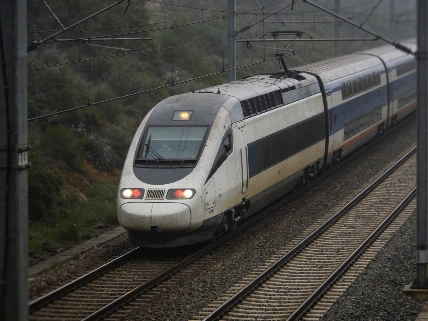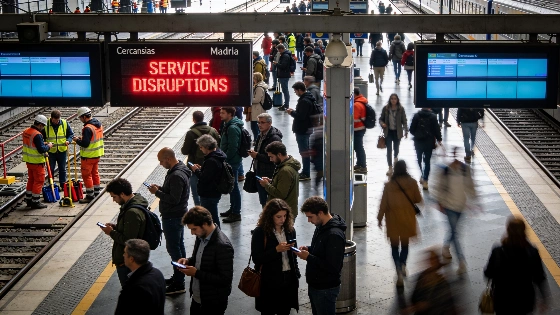
Madrid’s Cercanías network faces a week of major disruptions as critical works begin at Atocha Cercanías station. From July 17, the C-3, C-4 and C-5 lines will run on altered schedules and routes, affecting thousands of daily passengers. The works will introduce a new track layout intended to boost the Sol tunnel’s capacity by 33% and are scheduled to last until July 22, Cercanías said. Adif is carrying out the infrastructure works, while Renfe is communicating the resulting service changes. Renfe described the broader goal as expanding Atocha’s capacity for the benefit of the C-3, C-4 and C-5 lines, as reported by El Periódico de España.
During this period, the C-3 line (Aranjuez-Chamartín) will start and end its journey at Villaverde Bajo. Passengers travelling to Atocha or Chamartín must transfer to C-4 trains. The C-4a branch (Parla-Alcobendas/San Sebastián de los Reyes) will be suspended between Atocha and Parla, and all trains on this route will terminate at Atocha. Travelers heading towards Parla can switch to C-4b services (Parla-Colmenar Viejo), which will run as usual.
On the C-5 line (Humanes-Móstoles-El Soto), all trains will start and end at Atocha. Passengers travelling towards Humanes, Fuenlabrada or Móstoles-El Soto will need to change trains at Atocha to continue their journey on the same line. This arrangement divides the route at the station instead of closing the entire line, allowing services to continue on both sides of the works. Renfe has used weekend work windows for comparable Atocha projects, saying lower passenger numbers help limit disruption.
Once this initial phase ends, further changes are planned. From July 23 to August 16, only the C-5 line will be affected, with a complete closure between Villaverde Alto and Embajadores. During this period, trains between Humanes/Fuenlabrada and Villaverde Alto, as well as between Móstoles-El Soto and Embajadores, will run every 10 minutes throughout the day. Shuttle trains will also run from Villaverde Alto to Méndez Álvaro, stopping at Puente Alcocer, Orcasitas and Doce de Octubre, every 35 minutes.
From August 1 to 28, works will extend to lines C-2, C-7, C-8a, C-8b and C-10, though only train frequencies will be affected. On the weekends of August 29-30 and September 5-6, the Sol tunnel will close between Atocha and Nuevos Ministerios, affecting C-3 and C-4 services. Temporary termini will be set up at Atocha for C-3 and C-4 trains, and at Nuevos Ministerios for C-4 trains. Renfe will update passengers through station staff, announcements, signage, social media and WhatsApp* (принадлежит Metа, которая признана экстремистской организацией и запрещена в РФ).
A later phase of Atocha works shows how the same-line transfer arrangement operates in practice. For the weekend of October 17-18, 2026, C-5 services between Móstoles-El Soto and Humanes were scheduled to start and end at Atocha until 10:00, after which the regular route resumed. Passengers travelling beyond Atocha had to transfer to another C-5 train at the station. The same morning arrangement was scheduled for October 24-25. La Vanguardia reported Renfe’s explanation that the work was scheduled for a weekend, when passenger numbers are lower, to reduce the impact on travelers.
The works are scheduled for summer, when passenger numbers are typically lower, to minimize inconvenience. Cercanías says these are the final works related to the Sol tunnel that will disrupt regular service. The scale of the changes recalls other major Spanish transport stories with citywide effects, including ongoing challenges with tourist accommodation in Barcelona, covered in recent coverage of the city’s struggle with rising tourist apartment numbers.
Cercanías Madrid is one of Spain’s busiest commuter rail networks, serving millions of passengers each month. Atocha Cercanías is a central hub linking southern and northern suburbs with the city center. The Sol tunnel is a basic artery for cross-city travel, and work on this section affects services across the network. The current upgrades are expected to improve reliability and allow more flexible operations during incidents, benefiting commuters over the longer term. In the coming weeks, anyone relying on these lines will need to plan carefully, as alternative routes and transfer points become impressive for daily travel.