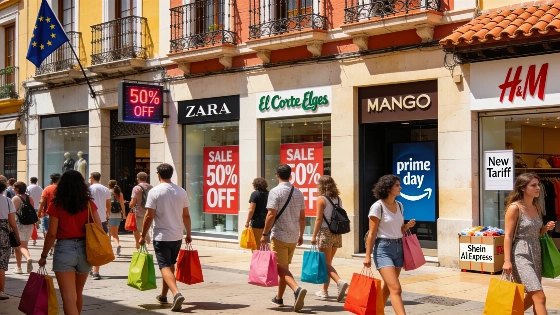
Retailers across Spain began their 2026 summer campaigns with impressive price cuts, including discounts of up to 50% on clothing, perfumes, cosmetics, appliances and electronics. The traditional July 1 launch date is no longer universal: retailers set their own calendars, with some starting in mid-June and others extending promotions into August.
Fashion remains the basic focus of the sales. Inditex brands, including Zara, offered discounts of up to 40% through August 9. Other familiar names, including Mango, H&M, El Corte Inglés, Scalpers and Kiabi, also launched campaigns. In eyewear, Óptica 2.000 cut prices by up to 50% on selected sunglasses throughout July and August. Decathlon ran promotions across products ranging from umbrellas and dumbbells to training gear and treadmills. Footwear chains such as Foot Locker and The North Face advertised discounts of up to 50% and 40%, respectively, while Merkal, Zapshop and Zalando also took part.
Perfume and cosmetics retailers joined the seasonal promotions. Kiko Milano offered discounts of up to 50% through August 26, while Sephora advertised the same maximum reduction. Primor ran a two-phase campaign, with discounts rising to as much as 85% toward the end of the sale period in early August.
Electronics and home appliances were also included in the markdowns. El Corte Inglés extended discounts across its departments, including technology and video games; Carrefour, Fnac and Media Markt ran their own campaigns. Amazon's Prime Day event took place from June 23 to 26, with promotions for Prime members across 35 categories, including clothing, kitchenware, beauty and electronics.
Alongside these domestic promotions, the EU introduced a temporary customs duty on July 1, 2026, for qualifying consignments valued below €150 and arriving from outside the bloc. The charge is €3 for each tariff category represented in a parcel, rather than automatically one fee per parcel; a mixed shipment can so incur more than one charge if its goods fall into different categories. The measure applies to relevant imports associated with Shein, Temu and AliExpress, not to all purchases made through those platforms. The temporary system is expected to remain until July 2028, when normal customs tariffs and the EU's centralised customs data platform are expected to replace it.
A further EU-wide customs handling charge of €2 per customs item is scheduled to take effect on November 1, 2026, also to the July duty. It is described as a customs-management fee, not a conventional tax on a product, and is expected to affect low-value imports from non-EU marketplaces. Its start date falls just before the Black Friday and pre-holiday discount period, adding another potential cost for qualifying orders. The new charges concern imported parcels; they do not apply simply because a Spanish retailer offers a discount.
Early reporting from Cyprus offered one indication of how the July duty may affect parcel flows: Cyprus Customs Department spokesman Giorgos Constantinou said parcels arriving from third countries had fallen by 30% to 35% since the measure began. Purchases from Temu and Shein remained attractive despite the added cost, the reporting said. The figure relates to Cyprus, not Spain, but illustrates how customs costs may influence cross-border buying without eliminating demand.
The wider regulatory backdrop also includes a reported €200 million European Commission fine imposed on Shein in May 2026 over shortcomings in its assessment of systemic risks associated with illegal products on its marketplace. That platform-governance action is separate from the customs duties, although both form part of increased EU scrutiny of major low-cost online retailers.
Online retail is a large part of Spain's commercial field. The Instituto Nacional de Estadística (INE) reported that electronic-commerce turnover reached €419.706 billion in 2025 and that 29.0% of companies with at least 10 employees made sales through e-commerce. These are business-level statistics, not estimates of household spending during summer promotions, and they cover domestic as well as other online sales. The customs changes, by contrast, apply to qualifying consignments imported from outside the EU. Retailers continue to compete through earlier starts, deeper discounts and longer campaigns, while the effect of the new charges on consumers will depend in part on the origin and tariff classification of the goods they order.