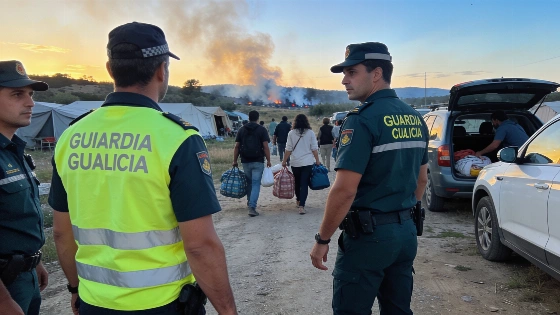
A 28-year-old man was arrested by the Guardia Civil’s Nature Protection Service (Seprona) on suspicion of starting the wildfire that broke out on Monday near Las Peñas de Riglos in Huesca. As the fire spread, emergency services evacuated 100 people from a nearby campsite on Wednesday night and closed the N-240.
Investigators linked the arrest to a suspected forest-fire offense. By Wednesday evening, the blaze had burned around 5,500 hectares. Authorities identified a storage area for construction materials left over from work on the A-132 road as a possible point of origin.
As the situation worsened, Santa Cilia and Binacua were placed under confinement orders, while the N-240 remained closed. The Guardia Civil organized a convoy of 20 vehicles to help residents of Villalangua and Salinas de Jaca collect personal belongings. The fire also prompted the evacuation of Villalangua, Salinas de Jaca, Ena, Centenero, Arbués, Alastuey, Bailo, Larués and Botaya, affecting a total of 477 people.
Hundreds of personnel from different agencies worked through the night to contain the wildfire and reinforce firebreaks, while limiting its spread. The emergency was classified at operational level 2 under Aragón’s Special Civil Protection Plan for Forest Fires. On Wednesday, flames crossed a road between Alastuey and Arbués, prompting authorities to tighten access restrictions and step up preventive measures in the area.
Subsequent reporting placed the investigation in a longer legal context. The detained man, a 28-year-old worker linked to the A-132 roadworks, was later released provisionally by the Audiencia Provincial de Huesca and remained subject to precautionary measures. Investigators reviewed security-camera footage that placed him near the suspected ignition point, but no recording showed the exact moment the fire began. The Jaca court later rejected the Aragón government’s request for renewed detention or, alternatively, a €100,000 bond. The investigation into the fire’s origin and the man’s possible responsibility remained open.
A separate court proceeding concerned the regional government’s public announcement of its request for provisional detention. The Tribunal de Instancia de Jaca archived that inquiry, concluding that the government had not acted unlawfully in disclosing the request. That decision concerned the government’s communication, while the investigation into how the fire started remained unresolved.
Provisional data from Spain’s Ministry for the Ecological Transition and the Demographic Challenge (MITECO) put the area burned since January 1, 2026, at 226,391 hectares in the period covered by the initial report, 38.2% above the 140,000 hectares recorded over the same period in 2025. Sara Aagesen, the ministry’s third vice-president and minister, described the summer as “extremely challenging,” saying it began unusually early and was the hottest on record. A recent report details how wildfires have already surpassed last year’s totals and continue to strain emergency resources nationwide.
Later national figures show that the season’s toll continued to rise. EFE Verde reported 275,209 hectares of forest burned through September 20, 2026, 2.5 times the 2016-2025 average. During the June-to-September maximum-risk period, 4,944 incidents accounted for 245,653 burned hectares. MITECO-based figures reported by Europa Press put the total through October 4 at 280,079 hectares across 8,635 fire incidents, with more than 10,000 firefighting flight hours and 50,259 water drops. These later totals use reporting cut-off dates after the provisional figure cited above.
By October, recovery planning had begun in affected Aragón municipalities. Environmental officials and local authorities were assessing burned areas and planning interventions, while removing damaged timber, repairing tracks and infrastructure, and considering new access routes. The work also included erosion-control and soil-retention measures, along with support for natural regeneration. The road to San Juan de la Peña reopened after about two months of closure. Access had first been restricted because of the fire and later because of risks from damaged forest stands and possible rockfalls. Parts of the forest near the Nuevo and Viejo monasteries were affected.
Wildfires are a recurring threat in Spain, particularly during periods of intense heat and drought. The rapid escalation of the Las Peñas de Riglos fire exposed the risks facing rural communities and the demands of coordinating an emergency response. Its aftermath has extended from evacuation and firefighting to legal proceedings, transport-safety decisions and long-term restoration of the affected field.