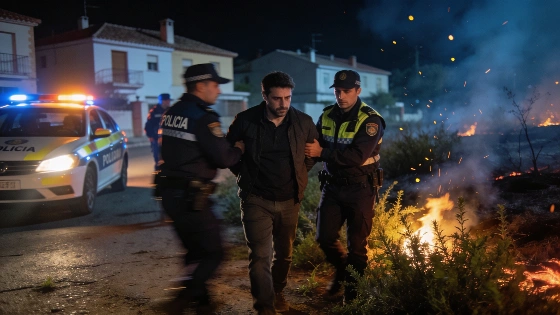
A man previously known to authorities for setting wildfires has been arrested in El Prat de Llobregat, Barcelona, after three new fires broke out in a vegetated area near residential buildings. The 37-year-old suspect already faced pending charges for earlier incidents in the same region. He was detained on July 18 in a joint operation by the Cos d’Agents Rurals and Mossos d’Esquadra.
Catalan police said the fires broke out in the early hours of July 18 in the Les Palmeres area, a peri-urban zone with dense grass and shrubs near several homes. Investigators found evidence that synthetic materials, which are highly flammable, were used to ignite the fires and accelerate their spread. The affected areas measured 24, 69 and 28 square metres, information from estimates by the Cos d’Agents Rurals.
During the investigation, officers identified the suspect as a local resident. When approached for identification, he reportedly reacted violently, hurling insults and threats at the agents. Mossos d’Esquadra detained him. Charges of resisting police intervention and making threats were added to the existing arson accusation. The case remains under investigation and subject to judicial proceedings.
The man’s record includes several previous arson cases, including one in the protected natural area of La Ricarda. He was awaiting trial for those incidents when the latest fires occurred. Authorities are continuing to gather evidence and clarify the circumstances surrounding the outbreaks. The Cos d’Agents Rurals is a specialized police body tasked with investigating wildfire origins and enforcing environmental protections. Its work also covers forests and biodiversity, as well as protected areas and other natural resources.
The agency’s broader workload reflects that wide mandate: it reported 203,663 interventions in 2025, 41% more than in 2024. It also handled 196,450 calls and recorded 8,213 complaints over environmental infringements. These totals cover environmental-policing work across multiple areas, not arson investigations alone. Catalonia’s later 2026 seasonal figures offer further regional context: about 450 fires were recorded between June and September, burning 4,833 hectares. The highest Alfa 4 fire-risk level was reached on 36 days. That compares with seven days in 2025; in 2024, it was reached on five days. Regional reporting attributed 21.48% of fires to suspected criminal causes. Negligence accounted for 20.85%, while accidents made up 19.28%. Lightning was responsible for 15.50%. The figures describe the season as a whole, not the cause of the Les Palmeres fires. More than eight in ten fires burned less than one hectare.
Fires near homes make peri-urban areas a particular public-safety concern. Catalan officials have also highlighted the severity of recent fire seasons: Salvador Illa, president of the Generalitat de Catalunya, described an earlier campaign that burned more than 60,000 hectares as a turning point in forest-management policy. He said the region was better prepared for the 2026 season. The fires have also renewed attention to law enforcement and justice in Spain. More details on a separate high-profile case can be found in the coverage of the Kitchen case trial.