Fifty-four of the 111 works selected for a Prado exhibition on Mariana de Austria were loans from other institutions, particularly Vienna’s Kunsthistorisches Museum. The project follows how portraits and other objects presented her in different roles, including as regent for her son, Carlos II.
That public image carried political weight. After Felipe IV died, Mariana governed during Carlos II’s minority amid a depleted treasury and a weakened army, while sections of the nobility opposed her. Juan José de Austria, Felipe IV’s illegitimate son, also challenged her position.
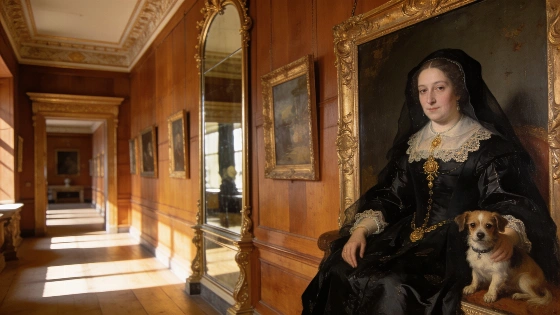
Mariana’s portraits made authority visible at a time when pamphlets and libels attacked her as a woman and a foreigner. One image places her in the Hall of Mirrors, dressed in mourning after Felipe IV’s death. The painting links the dog and her wedding ring to Carlos II; a memorial held in her hand adds another reference. Together, they frame loyalty and dynastic continuity, while also making a case for government.
The exhibition was conceived to trace nearly six decades of changing representation, from portraits made when Mariana was a child to images of her years as queen mother. The Prado’s restorers worked on 40 pieces for the project; ten were loans from other museums. The reported restoration work ranged from small repairs to more extensive cleaning, with treatment also carried out.
Mariana was born Maria Anna von Österreich on 22 December 1634, daughter of Emperor Federico III and María Ana of Spain. At eleven, she lost both her mother and her intended husband, Baltasar Carlos. With the Spanish crown lacking a male heir, Felipe IV committed to marry his niece. He was 30 years older.
The marriage by proxy took place in 1648 after a papal dispensation. Mariana’s journey to Spain lasted almost a year, with elaborate receptions in territories including Pavia and Milan. Her arrival was framed as a promise of peace and prosperity, as well as a successor for the monarchy.
Velázquez established the model for her image as queen consort after returning from Italy, and his workshop produced numerous copies. An X-ray of the paint layers revealed that the workshop used a white mark to bring more light to faces and skin tones. The curator, Noelia García Pérez, favoured a small square-format canvas in which Velázquez concentrated on Mariana’s face and left her dress unfinished.
The exhibition’s wider Habsburg setting has a parallel in a Granada display on Charles V, though Mariana’s story focuses on a later generation. The Prado project also included two reconstructions by Lorenzo Caprile: a nun-like mourning outfit and a dress built around a farthingale.
A drawing presents Mariana on horseback with a baton of command, an unusually military image for a woman in the Habsburg dynasty. The exhibition project was reported to have cost €1.27 million, according to Prado director Miguel Falomir.