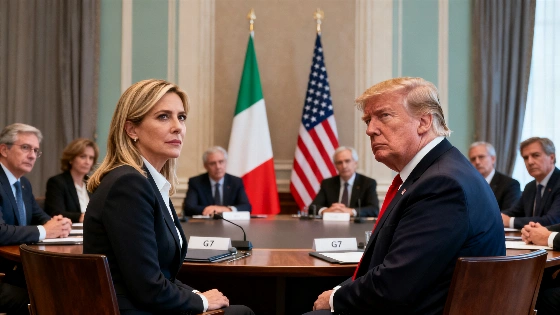
Italian Prime Minister Giorgia Meloni has rejected President Donald Trump’s claim that she pleaded with him for a photograph during the June 2026 G7 summit in Évian-les-Bains, France. The dispute became a diplomatic setback when Italian Foreign Minister and Deputy Prime Minister Antonio Tajani cancelled a planned visit to the United States. It marks a sharp deterioration in a relationship that had previously made Meloni a prominent interlocutor between Washington and the European Union.
Trump made the allegation in a phone interview with Italy’s La7 television, saying Meloni had “begged” him for a photograph and that he agreed because he “felt sorry for her.” Italian broadcasters carried the remarks with an Italian voice-over, rather than the original English audio, Thai PBS reported. Meloni called the account “completely made up,” said she was “frankly stunned,” and argued that “Italy never begs.” She cast the dispute as a matter of respect between allied governments, beyond a disagreement over a photograph.
The photograph claim became a diplomatic issue after Tajani cancelled his U.S. visit and described Trump’s remarks as “grave and offensive,” information from Thai PBS. Italian President Sergio Mattarella contacted Meloni to express support. Criticism also came from across the political spectrum: representatives of the opposition Democratic Party and Five Star Movement objected to Trump’s language, while members of Meloni’s Brothers of Italy party pointed to summit footage they said contradicted his account. The response extended beyond the governing coalition, turning the episode into a question of national dignity.
The dispute followed a period of growing friction over policy. Meloni, elected in 2022, attended Trump’s January 2025 inauguration as the only European leader present and was initially seen as a channel between Washington and the EU. Relations later soured amid disagreements over Iran and NATO-related expectations, along with Trump’s criticism of Pope Leo XIV. Trump later attributed the deterioration to Meloni’s refusal to help the United States in the conflict with Iran, according to BR24/BR.AZ reporting. In April, Trump questioned Meloni’s courage in an interview with Corriere della Sera; Meloni later called his comments about the pope unacceptable.
The G7 brings together Canada, France, Germany, Italy, Japan, the United Kingdom and the United States, with the European Union also participating. The Évian summit was intended to demonstrate coordination among major industrialized democracies. The public dispute between two leaders instead became a conspicuous sign of strain within the alliance. Meloni has since described her relationship with Trump as “cordial,” even as their exchanges have grown more personal and public. In a later Truth Social post, Trump shared a photograph of the two leaders with the caption “RESTRAINING ORDER NEEDED.”
The White House had not commented on the incident, the BBC reported. Tajani’s cancelled visit and Italy’s cross-party response offered immediate evidence of diplomatic fallout. The broader disagreements also point to potential complications for cooperation on security, economic and foreign-policy matters.