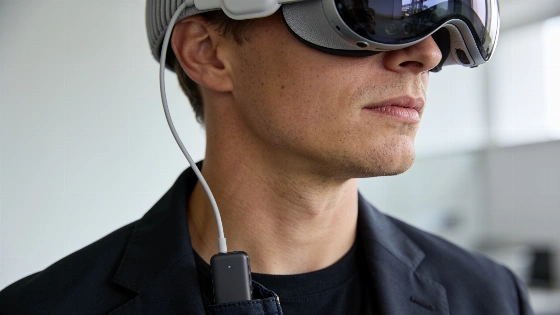
Meta has unveiled virtual reality glasses that weigh about 100 grams. The processor, battery and storage sit in a separate module, and the device is due in Spain in spring 2027.
Meta wants to tackle the weight that makes long virtual reality sessions uncomfortable. Its new Meta VR Glasses weigh about 100 grams. The processor, battery and storage sit in a separate module. The device is expected to reach Spain in spring 2027 at a price of 1,299.99 dollars. Meta's official blog confirms the spring 2027 release, putting the product in the premium segment from the start.
That figure is roughly one fifth of the weight of Quest 3. Instead of putting more than half a kilogram of hardware on the user's face, the design leaves only the displays and sensors on the head. The rest of the electronics sit in a module weighing about 300 grams. Users can attach it to a pocket or carry it in a bag. This design choice drives the fivefold reduction in headset weight described in Meta's Connect 2026 materials.
Meta Connect 2026 presented the Meta VR Glasses alongside other glasses and accessories, making the device part of a broader expansion of the company’s wearable ecosystem.
A thin optical cable connects the two parts. Shacknews also describes the external unit as the home for the computing hardware. The glasses keep the display and sensing components that sit on the user's face.
Meta showed the glasses during Meta Connect 2026. They look more like large conventional eyewear than a traditional virtual reality visor. That choice comes with a narrower field of view. Meta VR Glasses offer 70 degrees horizontally and 66 degrees vertically. Quest 3 reaches 110 by 96 degrees. The design favors lower weight, sharpness and a smaller form over wider peripheral vision. Meta's official announcement presents the glasses as a more eyewear-like alternative and acknowledges the narrower view compared with Quest 3.
The glasses use two micro-OLED displays with 2,412 by 2,288 pixels per eye. They can run at up to 120 Hz and offer a density of 37 pixels per degree. Qualcomm's new Snapdragon Reality Elite powers the system. The glasses also have 12 GB of RAM and 128 GB of storage, expandable through microSD.
Meta’s Connect 2026 announcements place the glasses within a wider wearable strategy rather than treating them as a standalone gaming headset. The company is expanding the range of devices and accessories around its glasses-oriented products as it develops a broader ecosystem for entertainment and everyday use.
Battery life is listed at up to three hours when playing high-resolution content. That limit, along with the external module, sets the product's main trade-off. The user carries less weight on the head but still has to manage another device and a cable.
Meta is also aiming the glasses beyond gaming. They will be the first virtual reality device certified as IMAX Enhanced. They will support 3D films, more than one hundred virtual sports events each year, and workspaces built around several virtual screens. Disney+, Prime Video, YouTube, Crunchyroll and other platforms are preparing compatible content. Meta's official materials present the device as a platform for cinema, virtual screens and productivity as well as interactive games.
The launch price puts Meta VR Glasses firmly in the premium segment. The engineering choice still tackles a physical problem that has limited everyday virtual reality more directly than another increase in processing power would. Meta has not made the hardware disappear. It has moved the bulk of it somewhere less punishing than the user's face. That gives the 100-gram format its strongest argument and makes it Meta's clearest step toward more practical extended virtual reality use.