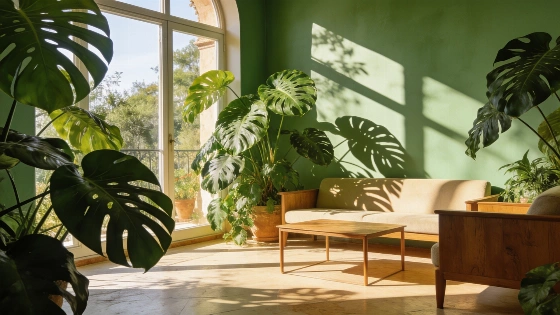
Monstera deliciosa, widely known in Spain as costilla de Adán, is a popular tropical foliage plant for indoor spaces. Its tolerance of medium to bright indirect light and ordinary household humidity makes it flexible to many homes, including during summer. Its broad, fenestrated leaves and ability to release water vapour through transpiration contribute to its appeal, although the plant is best regarded as a decorative addition rather than a replacement for mechanical cooling.
Native to the rainforests of Central America and southern Mexico, Monstera has long been grown as an indoor ornamental. Its leaf splits and holes are characteristic features shaped by the plant’s growth and light conditions; they do not demonstrate a special cooling function. Transpiration adds moisture to the air, but its local effect depends on room size and ventilation, as well as how much water is available. The plant may influence nearby humidity, but should not be relied on to lower a home’s temperature during a heatwave.
Monstera grows well in medium to bright indirect light. The Sill describes it as a plant that “thrives in indirect sunlight” and advises placing it outdoors in summer only in a fully shaded area to avoid leaf scorch. A window’s direction alone does not determine whether the light is suitable: filtered or indirect light is preferable to strong direct sun, which can damage foliage.
Watering should follow the condition of the soil rather than a fixed twice-weekly schedule. The Sill recommends watering every one to two weeks and letting the soil dry between waterings; Ed’s Plant Shop advises watering thoroughly once the top one to two inches of soil are dry. Pot size and drainage matter, while light and indoor conditions also affect how quickly the soil dries. Allow excess water to drain, and do not assume summer heat automatically means the plant needs more frequent watering.
Periodic misting is not a dependable way to cool a room or maintain humidity. GrowTropicals advises against misting, saying it “does little to raise humidity and can encourage leaf fungus.” For the plant, ordinary household humidity is generally adequate; where indoor air is particularly dry, a humidifier offers more consistent control. Keep the leaves clean by gently wiping away dust with a damp cloth, and protect the plant from strong direct sunlight and cold drafts.
Monstera can bring large greenery to a home and may modestly affect the humidity around it, but it should not be treated as a proven air purifier or a substitute for ventilation and cooling measures. Its reputation as a leading indoor plant for Spanish homes rests most securely on its ornamental qualities and ability to grow in suitable indoor conditions, not on a demonstrated reduction in room temperature.