A NASA satellite captured a large Saharan dust cloud sweeping across Mali in early September 2026. The event came after the usual dust season had mostly ended, but conditions allowed the cloud to reach the Atlantic. Scientists are watching for possible changes linked to El Niño.
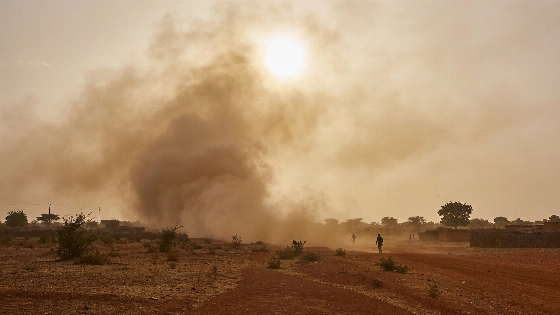
On September 5, 2026, NASA’s Terra satellite recorded a thick cloud of Saharan and Sahelian dust spreading over Mali. The timing caught atmospheric scientists off guard, since dust activity in the region usually drops off by early September. But the MODIS instrument on Terra showed a wide band of airborne dust moving west, going against the typical seasonal pattern. NASA’s Earth Observatory confirmed the extent and movement of the cloud using MODIS data.
This dust storm stood out not only for its size, but also for its path. Instead of staying over land, the cloud moved across Mali and neighboring countries, eventually reaching the Atlantic Ocean. Satellite images in the following days showed the dust continuing west. Still, NASA’s analysis suggests this particular cloud probably won’t make it all the way across the Atlantic—a journey more common from late spring through summer, when conditions are better for long-distance transport. NASA points out that seeing such a strong event at the end of the dust season is unusual, since activity usually fades by September.
NASA’s analysis indicates that while the dust cloud reached the Atlantic, it is unlikely to cross the entire ocean—a phenomenon more typical from late spring to summer.
NASA Science / Earth Observatory
Powerful convective storms called haboobs are behind these dust outbreaks. Tianle Yuan, an atmospheric scientist at NASA’s Goddard Space Flight Center, explains that these storms form when strong winds pick up loose surface material, sending it high into the air. The result is a plume of dust visible from orbit, sometimes traveling hundreds or even thousands of kilometers depending on wind patterns and the Saharan Air Layer—a dry, dusty mass that can ride above the continent. NASA attributes the September 2026 event to this kind of convective activity, with haboobs lifting dust into the atmosphere.
While the timing was unusual, the process itself is familiar. As summer ends in Africa, dust storms usually become less frequent, but leftover convective energy and loose sediments can still trigger major events. The September storm over Mali showed that even as the season winds down, the right mix of wind and surface conditions can send dust clouds high enough to be seen from space. Independent news reports citing NASA’s findings noted that the cloud covered parts of West Africa before its westward movement was tracked by satellites.
NASA scientists are also watching how larger climate patterns, especially the development of El Niño, might affect dust transport in the coming months. Changes in the intertropical convergence zone and shifts in convection could either increase or reduce future dust events. Yuan points out that drier conditions might create more loose sediment, but could also weaken the storms needed to launch big dust clouds, making the link between El Niño and African dust storms unpredictable.
NASA highlights that the September 2026 dust storm occurred at a time when such events are typically winding down, making it a notable late-season anomaly. Independent news outlets confirm that the dust cloud’s movement was tracked westward, but experts agree with NASA’s assessment that a full Atlantic crossing was unlikely for this particular event.
Nature World News
Tracking these dust clouds is more than a scientific exercise. Saharan dust can affect air quality, weather, and even ecosystems far from its source. For example, recent weather changes in Spain have shown how quickly atmospheric shifts can alter local conditions, though Saharan dust events are on a different scale.
As the dust cloud’s progress slows over the Atlantic, the episode highlights how unpredictable West African weather can be. Satellites like Terra are essential for catching these brief but important events, helping scientists track both immediate impacts and long-term trends. The September 2026 storm is a reminder that even when the season seems to be ending, the atmosphere can still deliver surprises—leaving researchers and local communities watching for what comes next.