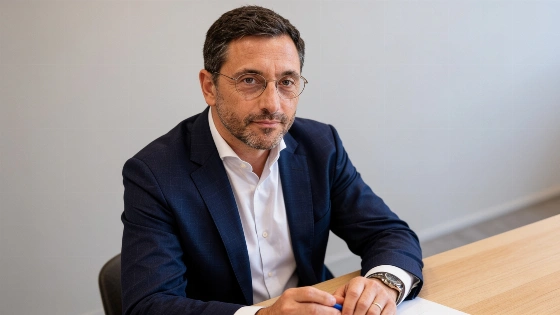
Christian Costaganna says the European Commission’s aggressive decarbonisation roadmap has not fully accounted for customer priorities or set out a coordinated support plan. The CEO of Nissan Motor España argues that incentives and charging provision must improve as the shift to electric cars gathers pace.
His priority is making electrification available in smaller cars. Costaganna says regulation sets the direction, but customers ultimately decide whether a technology succeeds. Strict emissions and safety requirements have helped push average vehicle prices higher, he says. The arrival of more models in smaller segments is beginning to widen the choice.
That distinction matters in Spain, where the upfront price remains a barrier even when running costs are lower. Costaganna estimates that public incentives can bring an electric car close to cost parity with a combustion model. In his calculation, support could help buyers recover the extra purchase cost in about a year to a year and a half. Without it, he estimates five to six years.
Those are Nissan’s estimates, not a universal saving. They assume electricity at €0.30 per kWh. Home charging with a smart charger could bring the cost below €0.10 per kWh, he says. At consumption of 14 kWh per 100 km, Costaganna puts an electric car’s energy cost at about €4.20 per 100 km, compared with €10.20 for a petrol car using 6 litres per 100 km.
The comparison covers energy costs rather than every aspect of ownership. Drivers also need to watch the condition of a car’s 12-volt battery. A Start-Stop fault can be an early warning, as this battery fault explainer describes.
Costaganna also says Spain needs more even coverage of charging points. He put the country’s total at about 55,000 rapid and semi-rapid chargers, describing the number per thousand vehicles as similar to France and Germany, while noting that territorial coverage still lags. He identifies a larger network and predictable incentives as key to accelerating adoption, alongside more affordable models.
Competition from Chinese manufacturers has helped bring lower-priced electric vehicles to market, according to Costaganna. He supports open competition under equal rules, while arguing that Europe and Japan need to strengthen their own industrial capacity and diversify supplies. China has a substantial role in batteries and raw materials. Nissan works with European and Japanese manufacturers, as well as manufacturers in China.
For Nissan, electrification does not mean a return to a purely petrol or diesel line-up for passenger cars in Europe. Costaganna says future models will be fully electric or use the company’s e-Power hybrid system. He also points to bidirectional charging: vehicle-to-home use is available, while feeding electricity back to Spain’s distribution grid would require regulation. A possible 2027 timetable has been discussed, but he does not present it as an established rule.