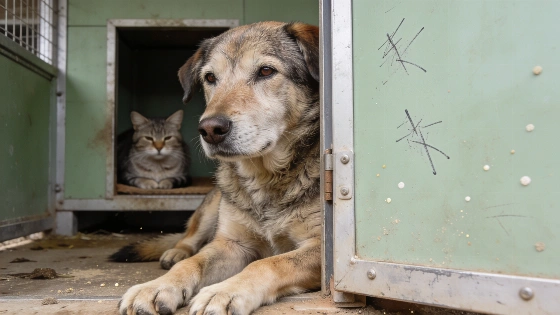
Cats accounted for 59% of adoptions recorded on the Adopta con Tiendanimal platform in 2025. Yet older animals and those with illnesses remain harder to place, including Papuchi and Amapola at a Madrid-area sanctuary.
At Salvando Peludos in Villamanta, nearly 240 dogs and cats are waiting for homes. Among them are Papuchi, a nine-year-old dog with leishmaniosis, and Amapola, a 12-year-old cat with a missing eye and mild ataxia.
Their cases show the barriers facing animals that shelters call «animales invisibles»: pets passed over by potential adopters because of their age, health or other characteristics. The report Mi historia continúa contigo, presented at the sanctuary, tracked more than 2,500 animals featured on the Adopta con Tiendanimal platform in 2025, using information from more than 370 registered shelters. Cats accounted for 59% of adoptions in that group; dogs made up 41%. The platform said an average of four animals a day found homes through it during the year.
Caroline Arrú, the company’s marketing director and co-chair of its ESG committee, said the figures reflect a shift towards cats in Spain, where dogs have traditionally been more commonly adopted. The report suggests cats may suit urban life because they adapt to smaller homes and are more autonomous. Its figures cover animals shown on the platform, not every adoption in Spain. Nationally, Fundación Affinity recorded 285,720 dogs and cats arriving at Spanish shelters in 2025: 169,268 dogs and 116,452 cats, or about 783 animals a day. Around 120,000 were adopted, approximately 42% of the intake, including about 72,000 dogs and 48,000 cats.
Adoption figures vary by region. Andalucía accounted for 43.15% of the adoptions recorded in the report. In the Community of Madrid, the figure was 15.09%; Cataluña represented 8.23%. The platform’s separate regional figures showed that 57% of the animals listed in Andalucía found homes, compared with 51% in Madrid. Andalucía had the largest number of animals listed on the platform, at 1,071. Madrid followed with 416, while Cataluña had 338.
Age is a clear dividing line. Among adopted dogs, 42.45% were between one and three years old, while 11.57% were under one. Dogs older than eight made up 9.29%. Fernando Sánchez, president of Fundación Salvando Peludos, said Papuchi’s age and leishmaniosis make it harder to find him a home. The disease deters some adopters, he said, although treatment involves one daily pill. Fundación Affinity’s figures show that adult and senior dogs and cats stay in shelters for an average of just over a year, compared with about three months for puppies.
For cats, the gap is sharper at older ages: only 1.61% of adopted cats were over 10. Cats aged six months to two years accounted for 49.01% of adoptions; those aged two to 10 made up 46.27%. Amapola was rescued from a person with Noah syndrome after living in overcrowded conditions with more than 50 cats. She now struggles to trust people and needs a home without other felines, said Katia Berazouskaya, coordinator at Salvando Peludos.
Age and illness are only part of the picture. In the study Él nunca lo haría, Fundación Affinity found that 77.6% of the organisations surveyed identified an animal’s behaviour as the main factor linked to longer stays in shelters. Other reported barriers included breeds considered potentially dangerous (68.2%), chronic illness (57.2%), large size (50.7%) and age (48%). Fundación Affinity also reported that 35% of people interested in adopting in 2025 did not ultimately take an animal home. Reasons included not finding one of a suitable size and disagreeing with adoption conditions. In a different care setting, a Barcelona care-search project has focused on helping families find residential homes for older people. Around 165,000 of the dogs and cats taken in by Spanish shelters in 2025 were still waiting for homes.