At the Salamanca firm Metabos, administrative worker Isabel García said she was the only one of 39 employees to join the 11N general strike. She understood the demands over housing but considered a strike the wrong way to address them, arguing that voters should decide at the ballot box.
That view differed from the campaign led by CCOO and UGT alongside the Sindicato de Inquilinas. The 24-hour nationwide action ran from midnight to midnight under the slogan «Salarios, vivienda, precios» (“Salaries. Housing. Prices.”). It was presented as Spain’s first general strike in 14 years and took place less than three weeks before the snap national election scheduled for 29 November. Alongside wage demands, the campaign called for government intervention in housing, a new minimum-wage agreement, restrictions on tourist apartments, action against property speculation and stronger renter protections, including automatic lease renewals.
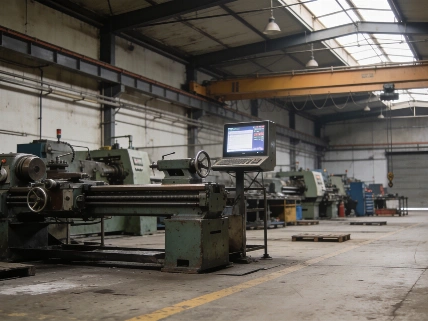
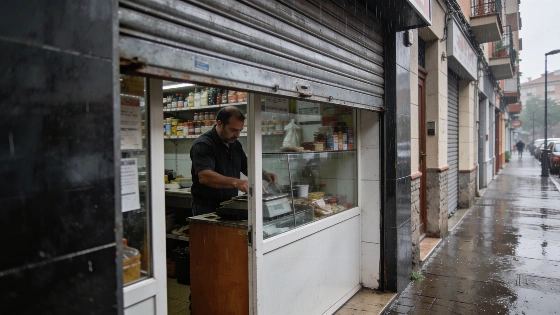
In Madrid’s Villaverde district, the industrial Polígono Talleres had more closed units than open ones. The picture was different among neighbourhood businesses: almost all shops had their shutters open or partly raised. The Mercadona supermarket at Puente Alcocer operated normally, while nearly all stalls at the Ciudad de Los Ángeles market served regular customers.
The local contrast came amid a nationwide stoppage whose impact varied by sector and area. Reuters reported that unions estimated four million workers took part; CCOO and UGT also reported stoppages of 90% in automotive and ports, 85% in meat processing, 82% in waste collection and 75% in energy. The unions’ figures described strategic sectors, while many smaller shops continued trading.
Local trade also continued despite the rain. Businesses’ reliance on essential services was clear in a separate report on power cuts in central Madrid.
Mónica de Gracia, who runs a health services clinic, said closing for a day would mean losing income while her business costs continued. She put it simply: «Si yo no trabajo, no cobro» (“If I do not work, I do not get paid”, translated from Spanish). She said staying open did not mean agreeing with every position on the strike; she could not afford to stop work.
Nancy, a Colombian and Spanish national who has lived in Spain for 27 years, was finishing a cleaning job in Calle Alcocer. With a daughter to support, she said she needed the money. She also described rising rents and difficulties for families trying to secure housing because of costs and paperwork.
Isla, who owns and works at the J & M café, said she needed to keep earning to cover her children’s university studies. Originally from Bolivia, she arrived four decades ago. She said she had heard conflicting accounts of the strike’s motives and did not feel able to judge its political background.
A survey by 40dB for EL PAÍS and Cadena SER, conducted ahead of the stoppage, found that 23% of employed respondents intended to strike. Another 36.3% said they would not take part, while 22.4% said they would not strike but supported the action and 10.3% were undecided.
Some workers were bound by minimum-service requirements. A postal worker in Villaverde delivered mail under those rules, while David drove an EMT line 22 bus on its assigned service. A municipal police officer in Vizcaya said officers were prohibited from striking.
Others worked but declined to discuss the stoppage. Two hairdressers from Tánger, Morocco, who had served the neighbourhood for 11 years, kept their busy salon’s shutter half lowered and refused photographs. For employees who did strike, the day meant deductions from basic pay, supplements and the corresponding share of extra payments; concern about job security was another reported deterrent, particularly for younger workers.
Jesús Pérez Aréjula, an inspector of high-voltage installations for the northern area of Red Eléctrica de España (REE), worked at the Valdeconejos substation in Teruel. He opposed the stoppage, saying work was necessary for social progress. His slogan was «¡A trabajar, España!» (“Back to work, Spain”, translated from Spanish).