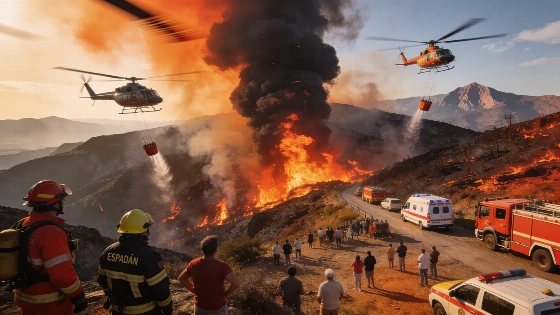
More than 300 emergency personnel are working to contain a wildfire in the Espadán mountains in Castellón. The blaze broke out amid soaring summer temperatures, forcing 500 residents to evacuate and affecting over 150 hectares of forest and rural land. Aerial firefighting units joined the operation overnight as crews stepped up efforts to stop the flames spreading.
Authorities have confirmed that the cause of the fire is under investigation. Government Delegate Pilar Bernabé said initial findings suggest the blaze may not have started naturally. Officials have opened a formal inquiry to determine whether human activity or negligence played a role in the outbreak.
Spanish emergency services are also battling a major wildfire in the Picos de Europa, where danger levels remain high. Firefighting teams have made enough progress for authorities to lift confinement orders in Ribota de Sajambre. In Grazalema, flames advanced and forced the evacuation of a hotel on Monday.
Elsewhere, firefighters have made progress in recent days. In Catalonia, crews managed to stabilize the wildfire near La Bisbal d'Empordà, which had threatened the Costa Brava and forced lockdowns in several towns. For more on the impact of that incident and the challenges faced by emergency crews, see this report on how firefighters battled the out-of-control blaze in Catalonia. Another worrying fire near the Sierra de Guara in Huesca has been brought under control.
Wildfire activity is surging as Spain endures the peak of its second heatwave this summer. The national meteorological agency, Aemet, has issued high-temperature warnings, with daytime highs of 35 to 40 degrees Celsius expected across much of the country at least through Wednesday. The extreme conditions are raising the risk of new fires and making existing blazes harder to contain.
National firefighting figures show the scale of the response required during the 2026 fire season. Spain’s Ministry for the Ecological Transition and the Demographic Challenge (MITECO) recorded more than 10,000 hours of aerial firefighting and 50,259 water drops in 2026. Castellón was among the provinces most affected, information from figures reported by Europa Press.
Wildfires are a recurring threat in Spain, particularly during periods of intense heat and drought. The Espadán mountains, known for their ecological value and biodiversity, are especially vulnerable in summer. Local authorities have urged residents to stay alert and follow evacuation orders promptly. Ongoing investigations into recent fires point to the need for prevention and a rapid response. Public cooperation also matters during emergencies.