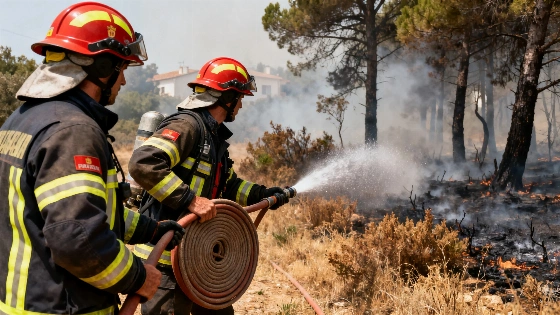
A fast-moving wildfire that broke out near La Bisbal d'Empordà on 3 July 2026 forced authorities to order lockdowns in seven municipalities in Catalonia. The blaze started at the roadside and spread into the Les Gavarres forest. By early afternoon, it was reported to have burned around 30 hectares. Strong tramontana winds and rugged terrain complicated firefighting operations, as emergency services redirected resources from fires in Vilavenut and Bescanó to contain the growing blaze.
The fire advanced into the Les Gavarres massif, a green zone spanning 350 square kilometres between Baix Empordà and Gironès. The municipalities placed under lockdown included Calonge i Sant Antoni, Castell d'Aro, Platja d'Aro i S'Agaró, Cruïlles, Monells i Sant Sadurní de l'Heura, Forallac, La Bisbal d'Empordà, Llagostera and Santa Cristina d'Aro. Evacuations also began in the Vall Repòs urbanization of Santa Cristina d'Aro and a neighbourhood in Cruïlles.
Firefighters said the situation had exceeded their immediate capacity to extinguish the blaze, though operations continued on several fronts. The fire was expected to reach the Puig d'Arques area, and authorities anticipated it would remain active for hours. More than 60 ground and aerial firefighting units were deployed. Shifting winds and difficult access contributed to new hotspots. Smoke was visible across the region and from neighbouring comarques.
About 100 children were at the Pou del Glaç holiday camp when the fire broke out. The camp, about a kilometre from La Bisbal d'Empordà and within the forest, was placed under lockdown as a precaution. The GI-660, known locally as the Carretera de La Ganga, was closed because of heavy smoke and safety concerns. The route is popular with cyclists and connects several affected towns.
Authorities investigated the cause of the fire. One working theory was that sparks from a radial saw being used to install a fence near the road ignited vegetation, though officials considered other possibilities. The tramontana wind also generated secondary fire fronts, complicating the response. Civil Protection issued an alert mid-morning, telling residents in the Sant Pol neighbourhood and children at the Pou del Glaç camp to remain indoors. By early afternoon, residents of homes in the fire's path had been ordered to shelter inside.
Local officials prepared the Firal pavilion in La Bisbal d'Empordà as a potential shelter. The area was at level 3 of the Alfa plan, indicating very high wildfire risk. Activities that could pose a fire hazard were suspended, including burning agricultural waste and using power tools near forested areas. Open flames were prohibited, including in designated camping zones.
The scale of the disaster became clearer in the Generalitat de Catalunya's later seasonal assessment: the La Bisbal d'Empordà wildfire ultimately burned approximately 2,000 hectares in Les Gavarres, becoming the largest fire recorded in Catalonia during the 2026 season. That was about 41% of the 4,833 hectares burned across the region between 1 June and 15 September. The assessment counted 450 fires over that period, with eight in ten affecting less than one hectare. It also recorded 36 days of extreme fire risk, compared with seven in 2025. Information from figures reported by L'Indépendant, the Generalitat described the season as marked by the virulence and simultaneity of fires amid high temperatures and territorial vulnerability.
Subsequent observations documented signs of recovery in Les Gavarres, including new green shoots and trees that survived the fire. A report by Ràdio Capital de l'Empordà quoted an observer describing “a quantity of green shoots and trees that are not growing back-they never died.” Burned area does not mean every tree was killed: fire severity can vary across slopes, vegetation and individual stands. Post-fire management has focused on supporting forest regeneration and reducing the risk of renewed burning.
Wildfires are a recurring threat in Catalonia, particularly during periods of strong winds and dry conditions. Les Gavarres, with its extensive pine and oak forests, is especially vulnerable. The Alfa plan forms part of Catalonia's broader wildfire-prevention strategy, which includes restrictions on outdoor activities and increased surveillance during high-risk periods. The 2026 seasonal figures show the pressure created by repeated extreme-risk days and simultaneous fires. Recovery observed in the massif also shows that burned landscapes can retain surviving trees and regenerate.