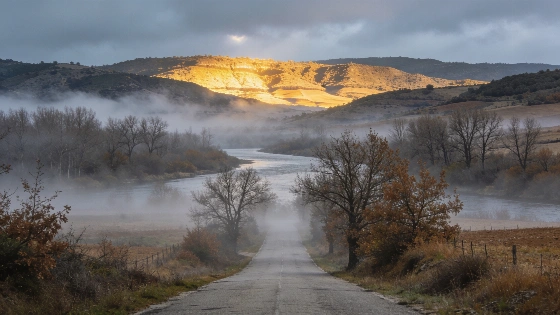
Yellow warnings apply in the Tajo valley around Cáceres and the Guadiana valley near Badajoz, where dense fog is expected. Reduced visibility is also forecast across much of the plateau and the Ebro depression. AEMET’s yellow-level warning for the Tajo Valley runs from midnight to 11:59 a.m. on Sunday, 29 November. It forecasts visibility of 200 metres, with a 40% to 70% probability of the event. The alert was published or updated on 27 November.
On Sunday 29 November, the main weather risk is confined to a few areas. A front will move from west to east across the far north, bringing rain first to Galicia and then to the Cantabrian communities. In a special forecast for EL PAÍS, Aemet spokesman Rubén Del Campo describes a generally stable day, with fog as its most significant feature. Earlier yellow fog alerts covered La Siberia extremeña on 27-28 November and the Guadiana Valley on 28 November; visibility was forecast at 200 metres.
The timing matters for voters in the north. Rain is expected in Galicia overnight, then mainly in Asturias and Cantabria as polling stations open. It should ease in Asturias after midday but continue in Cantabria, with showers reaching the Basque Country. Del Campo expects the rain to stop around seven or eight in the evening. The heaviest falls in Asturias and Cantabria are forecast at 5 to 10 litres per square metre. No severe conditions are expected.
Fog should begin to lift around midday or early afternoon, leaving mostly clear skies across the rest of Spain. AEMET’s mountain forecast for 29 November also notes locally reduced visibility from low cloud and probable light precipitation in the area covered. The snow line is forecast to fall from 2,400 metres to 2,100 metres. Some drizzle may affect the Mediterranean coast of the Levant and Ibiza, but only in small amounts. Scattered rain is possible in the north of the more mountainous Canary Islands.
Temperatures are expected to stay typical for late November. Early voters in inland areas should dress warmly: Ávila and Teruel are forecast to reach 2°C at first light. Minimums in Albacete, Córdoba, Cuenca, Girona, Lugo, Madrid, Pamplona, Segovia, Toledo and Zaragoza are expected to range from 3°C to 5°C. Frost is forecast only in the mountains.
Seville is expected to have the warmest maximum on the peninsula at 21°C. Burgos is forecast to reach 9°C; Valladolid, Vitoria, Segovia and Ávila are expected to record highs between 10°C and 12°C. Madrid is forecast to reach 13°C. Ceuta may reach 20°C, while Santa Cruz de Tenerife and Las Palmas are expected to reach 25°C. Mediterranean cities will generally be near 20°C. Barcelona is forecast at 16°C, with highs of 18°C to 20°C in Alicante, Almería, Castellón, Valencia, Murcia and Málaga.
Research on election turnout offers limited grounds for predicting how weather might affect the result. Joaquín Artés of the Universidad Complutense de Madrid led a study of municipal elections from 1987 to 2011, published as The rain in Spain: Turnout and partisan voting in Spanish elections. It found that rain reduced turnout by less than half a percentage point, a change that could affect a seat but was not enough to produce a major reversal. The study also found that rain benefited the right by discouraging voters less firmly committed to turning out, including a traditionally less mobilised left-wing electorate. The effect of good weather on turnout in Spain has not been studied. RUSSPAIN.COM has also covered the close contest and policy divisions in its election campaign report.