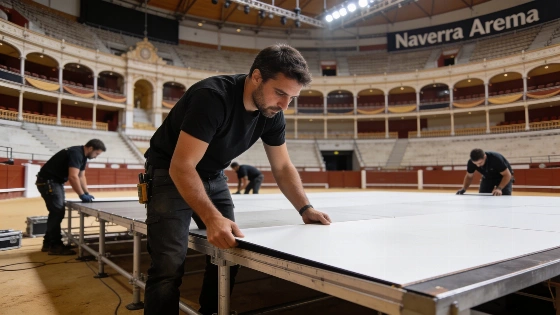
The 6 February ceremony will take place at the Navarra Arena, a sports and concert complex that opened in 2018. RTVE and El País confirmed the Academy chose Pamplona as part of its wider plan to take the Goya ceremony beyond Madrid. Navarra also wants the event to reach people across the region.
María Chivite described the gala as a demanding operation in an interview with Hoy por Hoy Navarra. The region has experience organising major national and international sporting events, she said, but a film awards ceremony calls for different preparation. The Academy of Cinema also pointed to local professionals’ work and the growth of production activity in Navarra.
The Navarra Arena’s existing infrastructure will be central to the logistics of the 41st Goya ceremony, El Mundo reported.
The strongest local case now extends beyond culture.
Information from the president, filming incentives have helped build an audiovisual industry and create jobs around it. That gives the Goya ceremony a purpose beyond one night in Pamplona. Navarra will have a chance to show that filming in the region has created a professional base. The government wants to strengthen the sector.
A wider programme is under discussion for 6 February. The administration has asked the Academia de Cine to include talks and training activities, along with meetings and discussions, in different parts of Navarra. ABC and El País report that the programme would spread the event across several locations in the autonomous community. The aim is for the gala to belong to the whole region, not only to people inside the Navarra Arena.
The 2027 ceremony will be the first time the Goya awards are held in Navarra. The calendar includes the announcement of nominations on 15 December 2026 and the traditional nominees’ gathering on 11 January 2027, extending the event beyond the gala itself, Noticias de Navarra reported.
Navarra already has a long connection with Spanish cinema. Chivite cited the Festival de Ópera Prima de Tudela as one example. The Goya gala would add a national event to that film calendar, alongside the regional activity described in San Sebastián coverage.
Local talent should also feature in the region’s presentation. Chivite singled out Carlos González, an actor from Cintruénigo and one of the protagonists of La bola negra. The interview described the film as one of the season’s most prominent. Her wider point was that professionals born or developed in Navarra should be visible when the national industry arrives in Pamplona.
Public access is still undecided. Chivite said the Academia de Cine is responsible for access to the Navarra Arena. She does not yet know how the public will take part, though she has told the academy that the government wants citizens involved in some form.
The next fixed date is 15 December, when the nominations will be announced. The traditional nominees’ meeting is set for 11 January 2027, information from the calendar reported by Noticias de Navarra and Heraldo.
The guest list will take shape later.
Until then, Navarra is putting its event planning and public-involvement plans on display, along with the credibility of an audiovisual sector built through recent growth. The gala will matter beyond the red carpet if the promised activities give that investment a lasting public role.