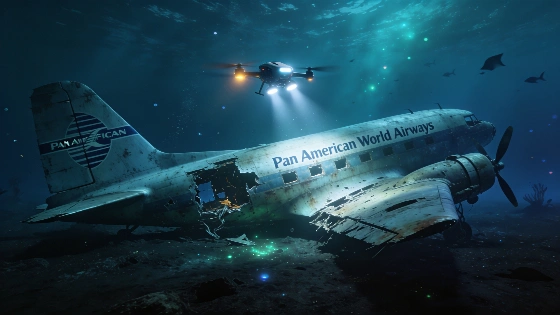
A Pan American Airways plane lost in 1952 has finally been found off Puerto Rico. The discovery ends decades of uncertainty about the crash site. The tragedy led to major reforms in air safety procedures.
The long-missing wreckage of the Pan American Airways Douglas DC-4, known as the "Clipper Endeavor," has been identified on the Atlantic seabed north of Puerto Rico, closing a chapter on one of aviation’s enduring mysteries. The aircraft, which crashed shortly after takeoff on April 11, 1952, was carrying 64 passengers and five crew members. Although all survived the initial impact, only 17 people—12 passengers and all crew—were rescued, while 52 lost their lives as the plane sank.
The search, led by the Air/Sea Heritage Foundation in collaboration with Deep Sea Vision and the Discovery Channel’s "Expedition Unknown," used high-resolution sonar and autonomous underwater drones to pinpoint the wreck at a depth of nearly 600 meters. The breakthrough came when images revealed the unmistakable Pan American logo and the aircraft’s name, still visible after more than seven decades underwater.
For years, the general area of the crash was known, but the precise location of the wreck eluded investigators and families. The tragedy, remembered in Puerto Rico as 'La Tragedia del Viernes Santo,' became a turning point in aviation history. The aftermath prompted significant changes in airline safety, including the introduction of mandatory pre-flight safety briefings and emergency procedure demonstrations—measures now standard across the industry.
Despite the presence of life rafts and flotation devices on board, many passengers remained in their seats and were unable to escape as the aircraft sank. The reasons for this remain unclear, but the incident highlighted critical gaps in passenger preparedness and emergency response at the time. Russ Matthews, president of the Air/Sea Heritage Foundation, noted that the story of the "Clipper Endeavor" had faded from public memory, despite its impact on global aviation safety standards.
The operation’s success was announced by Discovery, which emphasized the technical challenges of locating the wreck in deep, shifting waters. The find not only brings closure to families but also serves as a reminder of the risks faced by early commercial aviation. The story of the "Clipper Endeavor" stands alongside other notable losses in the world of transport and culture, such as the recent passing of Joan Roca, a founding member of Antònia Font, whose influence on Mallorca’s music scene was highlighted in this report.
Today, the discovery of the Pan Am wreck underscores the evolution of air travel safety and the importance of learning from past tragedies. The reforms that followed the 1952 disaster continue to shape the protocols and training that protect millions of passengers each year. The site, now finally located, stands as a testament to both the progress and the enduring risks of aviation.
For context, Pan American Airways was one of the world’s most prominent airlines in the mid-20th century, pioneering transatlantic and transpacific routes. The DC-4 was a widely used long-range aircraft of its era. The loss of the "Clipper Endeavor" contributed to a broader industry reckoning with passenger safety, influencing regulations not only in the United States but also internationally. The recovery of the wreckage, after 74 years, offers a rare opportunity for further study and remembrance of those lost in one of the defining air disasters of the 1950s.