Paul McGrath secured Spain's first international gold in the European half marathon walk. The Barcelona-based athlete now targets Los Angeles, balancing elite sport, journalism studies, and his religious faith.
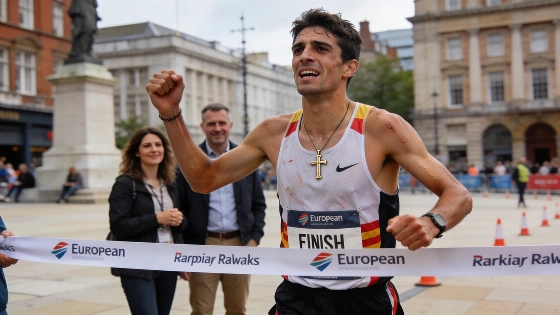
Paul McGrath has redefined the ambitions of Spanish race walking after claiming his first international gold at the European half marathon walk in Birmingham. The 24-year-old, known for his height and striking presence, crossed the finish line with a personal best of 1:23:23, immediately dedicating his victory to his faith and family. His performance not only marked a milestone for Spanish athletics but also set a new personal bar: McGrath now considers anything less than gold a disappointment in future competitions.
The athlete, who grew up in Barcelona with Scottish and Catalan roots, celebrated his win in Victoria Square, a location that has become symbolic for Spanish sport. McGrath’s family background is international—his father James is Scottish, descended from Irish immigrants, and his mother Isabel is Catalan. This blend of cultures has shaped his approach both on and off the track. After his triumph, McGrath announced plans to return to the Montserrat monastery, a tradition he began after winning bronze at the World Championships in Tokyo and silver at the previous European event in Rome. This time, however, he will travel by car, citing the need to rest his hamstrings after the demanding race.
McGrath’s preparation for Birmingham was meticulous. He trained at altitude in Font Romeu and Glasgow, focusing on hill work to build endurance and speed. Despite minor physical issues in the final kilometers, he maintained control and finished strongly. His tactical approach was evident as he quickly distanced himself from key rivals, including the fast Italian competitor Fortunato. McGrath’s analytical mindset extends beyond athletics—he is an avid student of the sport, often reviewing race footage and drawing inspiration from elite athletes like Josh Kerr.
Alongside his sporting career, McGrath is completing a journalism degree and will soon begin an internship at ABC in Barcelona. He describes a period of uncertainty after the Tokyo World Championships, which led him to focus intensely on his studies. According to statements to EL MUNDO, his mother expressed pride in his academic achievements. McGrath compares the pressure of major competitions to university exams, crediting his coach Alejandro Aragoneses for his development. He began race walking at age nine, inspired by watching Miguel Ángel López win European gold. To avoid injuries, he supplemented his training with long cycling sessions, another of his passions.
Race walking has a long tradition in Spain, with athletes like Jesús Ángel García Bragado and Miguel Ángel López achieving international recognition. The discipline requires a unique combination of endurance, technique, and mental resilience. McGrath’s recent success highlights the ongoing strength of Spanish athletics and the increasing expectations placed on its young talents. His commitment to both sport and education reflects a broader trend among elite athletes in Spain, who often balance demanding training schedules with academic or professional pursuits. As McGrath prepares for future challenges, including the Los Angeles Olympics, his story underscores the evolving landscape of Spanish sport and the high standards now expected at the international level.