Pedro Sánchez urged a national agreement on climate action during his visit to Los Gallardos, Almería, where a deadly wildfire has prompted coordinated efforts from all levels of government. The call comes as climate risks intensify.
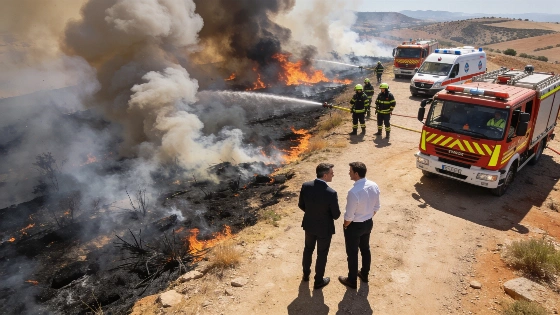
Spain’s Prime Minister Pedro Sánchez has called for a sweeping national pact to confront the escalating climate emergency, making his appeal during a visit to the wildfire command center in Los Gallardos, Almería. The visit comes as authorities battle a deadly blaze that has devastated the region since Thursday, highlighting the urgent need for unified action across all levels of government.
Standing alongside Juanma Moreno Bonilla, recently re-elected as Andalusian president through a coalition with Vox, Sánchez emphasized that climate change is now a direct threat to lives. He pointed to last year’s figures, when Spain accounted for a third of all scorched land in Europe, as evidence that prevention and education—especially among young people—must become national priorities.
During his address at the Levante Almeriense Fire and Rescue Consortium, Sánchez expressed condolences to the families of victims and wished a swift recovery to those injured. He praised the coordinated response from local mayors, the General State Administration, the Almería Provincial Council, and the Junta de Andalucía, noting that all available state resources have been mobilized for firefighting, investigation, and reconstruction efforts. Many of the victims were foreign nationals, a fact that has deeply affected local communities where they were well integrated.
Moreno Bonilla, speaking just before Sánchez, acknowledged the rapid and destructive nature of the fire, which has already burned three times more land than at the same point last year. He announced that the region has now moved to "Situación Operativa 0," indicating that the fire is under control but not yet fully extinguished. The Andalusian leader warned that the combination of a rainy year, resulting in dense undergrowth, and intense heat waves has created ideal conditions for wildfires to spread quickly. He urged residents to remain vigilant for smoke, suspicious activity, and to heed official warnings as the summer progresses.
Both leaders agreed that the climate crisis is producing increasingly unpredictable and severe weather events, with Moreno Bonilla describing the current situation as a sign of "climatic disorder". The need for public awareness and institutional cooperation was a recurring theme, as Sánchez called on all sectors of society to contribute to a comprehensive climate agreement.
This high-profile visit and the cross-party cooperation echo broader political dynamics in Spain, where alliances and emergency responses often intersect. For example, recent political maneuvering and coalition-building have shaped the landscape, as seen in the coverage of internal party shifts and leadership changes, such as those detailed in the recent analysis of Sumar’s restructuring after Yolanda Díaz’s departure.
Spain’s vulnerability to wildfires has grown in recent years, with climate change intensifying both the frequency and severity of such incidents. According to the European Forest Fire Information System, Spain consistently ranks among the countries most affected by wildfires in the EU. The government has increased investment in firefighting resources and prevention campaigns, but experts note that long-term solutions require not only emergency response but also landscape management, rural development, and sustained public engagement. The events in Almería serve as a stark reminder of the stakes involved and the necessity for coordinated, forward-looking policies at both regional and national levels.