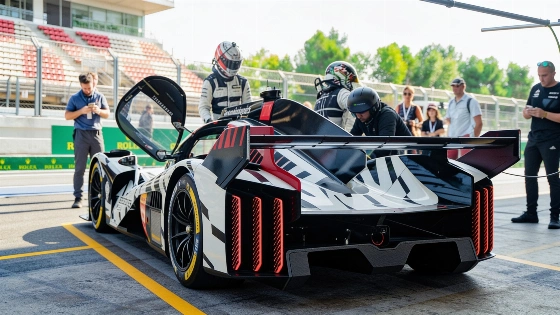
The LMH will keep its name but is expected to return with a more conventional design and a renewed performance focus. Peugeot is developing the next version for 2027 after a modest WEC record.
A camouflaged prototype spotted at Paul Ricard points to a substantially different Peugeot 9X8 for the 2027 World Endurance Championship season. It will keep the 9X8 name, but its visible low nose and high rear wing signal a shift from the current car’s unusual proportions.
Peugeot Sport’s next step follows a difficult WEC run: the team has scored one podium in three and a half seasons. Director Emmanuel Esnault says the aim is to make the 9X8 a regular contender among the leaders. For 2027, he says, development will take a renewed approach to performance and efficiency, alongside the design changes. Work began in April 2025, and Esnault has led the team since January 2026. Engineers have focused on the current car’s sensitivity to bumps and aerodynamic instability. After wind-tunnel testing, they completely redesigned the bodywork. Peugeot planned to complete homologation by mid-December, ahead of the 2027 season opener in Qatar at the end of March.
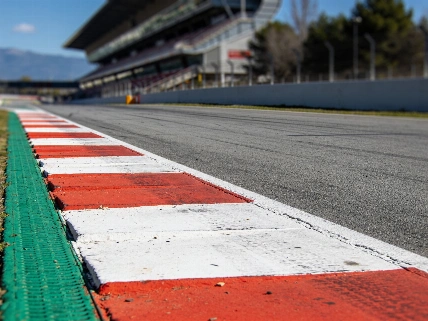
The Barcelona race offered a close look at the current car. Its large rear wing now sits above a black-and-white tiger-stripe livery, with red replacing the previous kryptonite shade. The 9X8 initially drew attention because it ran without a rear wing, an unconventional choice Peugeot later abandoned. At the six-hour WEC race on 18 October 2026, early rain gave the cars chances to overtake and stay in contention. Once the track dried, Peugeot’s pace fell back to its current level. Paul di Resta, Nick Cassidy and Alex Quinn finished 12th in the No. 93 car, while the No. 94 of Loïc Duval, Malthe Jakobsen and Théo Pourchaire came home 13th. Neither car scored points. Team principal Emmanuel Esnault said Quinn, 25, had settled into the team and adapted quickly on his first start in the 9X8’s top endurance-racing class. Quinn joined for the final rounds of 2026 in place of Stoffel Vandoorne, who was due to return to Formula E.
Esnault has also pointed to a weakness in the current car’s aerodynamic balance. It shifts through corner entry, the apex and the exit, with the biggest effect in long corners. He has said Peugeot cannot yet fight consistently with the championship’s leading contenders. The team’s next scheduled race for the current car is the season finale at Monza on 8 November 2026.
Peugeot is developing the replacement as an LMH, or Le Mans Hypercar. The manufacturer develops its own chassis and powertrain, unlike LMDh rivals, which use standard components such as the chassis and electrical system. The Peugeot’s 2.6-litre twin-turbo V6 drives the rear wheels, while a 200 kW electric motor-generator powers the front axle. A 900-volt battery, developed by Peugeot Sport with TotalEnergies and Saft, stores and deploys energy. Under the championship’s Balance of Performance rules, combined output is set at 520 kW, or 707 horsepower.
The Barcelona event was the WEC’s first race in Spain; previously, the championship had held only tests in the country. It came as disruption linked to the Middle East crisis opened the way for traditional venues elsewhere to host pending championship dates. Peugeot’s race programme reflects a different kind of manufacturer commitment from Toyota’s hydrogen plans for Spain, which centre on infrastructure and supply partners.
Peugeot has won the 24 Hours of Le Mans three times, in 1992, 1993 and 2009. In 2026, the marque marks a century since its debut in the race. The team’s final scheduled WEC round of the season is at Monza on 8 November.