Toyota says Spain could host hydrogen projects, but vehicles alone will not build a market. Yoshihiro Nakata says affordable fuel and refuelling infrastructure depend on a wider supply chain.
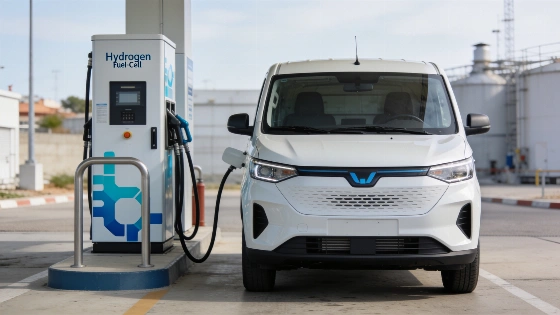
Since 2022, Toyota has produced fuel-cell technology for Europe at its technical centre in Belgium. Yoshihiro Nakata, president and CEO of Toyota Europa, says Spain could offer opportunities for hydrogen projects if the surrounding industry develops too. Toyota’s work covers production and transport, as well as storage and use, alongside the vehicles themselves.
Toyota can supply vehicles, Nakata said in an interview with elEconomista.es in Brussels. A market would also need hydrogen at competitive prices and a refuelling network. Producers would have to take part, along with companies handling transport and distribution. Toyota España has also said cooperation with public authorities and private companies matters for expanding hydrogen mobility, particularly in public transport.
The company is positioning itself ahead of the European Union’s debate on the Industrial Acceleration Act, or IAA.
Current rules provide for zero emissions from new passenger cars in 2035. The European Commission has opened the door to synthetic-fuel cars accounting for 10% of the market. Separately, a proposal discussed by the European Committee of the Regions would set a 90% reduction target for new cars’ tailpipe emissions from 2035. Measures such as low-carbon steel could provide flexibility for the remaining 10%; e-fuels and biofuels are also under discussion. Toyota argues that decarbonisation should leave room for several technologies.
Battery-electric vehicles are one route. Toyota is also developing hydrogen fuel-cell systems and exploring biofuels. With Bosch and Repsol, it is working on a project to measure emissions from combustion vehicles running on fuels made from renewable energy and biomass. BMW is involved too.
A six-month Spanish trial used about 5,700 litres of petrol made entirely from renewable sources. Toyota and BMW took part, as did Bosch and Repsol. Járműipar.hu reported a 70% reduction in carbon emissions during real-world driving.
Toyota argues that hydrogen could help in industry and heavy transport, where battery electrification is harder because of battery weight and charging time. Toyota and Isuzu have developed the Sora hydrogen bus for public transport. From 2027, the company is working with Scania and Iveco on fuel-cell systems for industrial vehicles. It is developing passenger-car applications with BMW and plans to add the technology to the Toyota Hilux in 2028. Nakata identifies hydrogen’s high cost and the shortage of infrastructure as key barriers to wider adoption.
The policy debate also turns on what counts as “Made in Europe” under the IAA. Automotive associations have proposed a 70% European-components threshold. A European Commission proposal discussed for electric-vehicle production would require 70% of components, excluding the battery, to come from the EU. Toyota warns that an EU-only definition could shut out established supply chains in Turkey and the United Kingdom, where it also has factories.
Toyota wants the definition to include trusted partners such as Japan. Nakata cited shared standards for trade and manufacturing, as well as data protection and human rights. He said the EU’s 11-million-unit car market could reach 31 million with partner countries, compared with China’s 27 million. The broader approach echoes the employment and electric-car push in Volkswagen’s Europe plan, though Toyota also wants non-EU partners included.
Toyota’s industrial strategy follows the same preference for keeping options open. The company is developing a platform for different battery sizes and powertrains, including battery-electric vehicles and hybrids. It expects the technology to generate close to €1 billion in sales in 2032, including sales to other manufacturers. Its wider decarbonisation approach includes hydrogen fuel cells and renewable fuels, alongside batteries and hybrids.
The programme also covers smaller, more efficient combustion engines and silicon-carbide power electronics. Toyota plans a naturally aspirated 1.5-litre engine to replace current 1.8-litre units. It is also developing a 1.5-litre three-cylinder, with a turbocharged version expected to deliver performance comparable to current naturally aspirated 2.5-litre engines. A separate 2.0-litre turbo is designed for different vehicle types, including competition cars.
In Spain, Toyota has been the best-selling passenger-car brand for four years, with a market share close to 10%, according to the source material. The company shares a commercial-vehicle production base with Stellantis in Vigo. Fiat and Peugeot are assembled there, alongside Opel and Citroën. The Toyota Proace City is built at the site too. Nakata said Toyota wants that cooperation to continue.