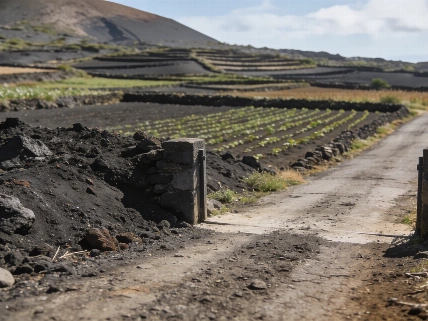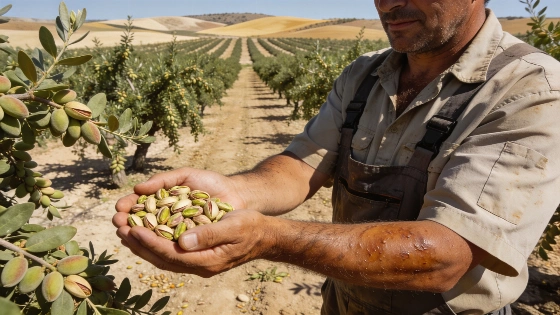
When Juan José Chacón switched from olives to pistachios in Pozuelo de Calatrava, Ciudad Real, he began with a €6,000 bank loan and a bet on a crop few in Spain had considered. Today, he says his pistachio business brings in €650,000 a year, a striking figure in a region reshaping its agriculture.
Regional figures published on June 25, 2026, show that Castilla-La Mancha’s pistachio acreage has grown roughly 17-fold since 2012, reaching nearly 70,000 hectares. The region harvested about 11,000 tonnes of dried pistachios in 2025, 30% above initial forecasts. But planted area and productive area are not the same: sector figures for 2025 put the crop at 68,311 hectares, of which 24,164 hectares, about 35%, were already producing. That productive area had grown 47% in a year, while many younger orchards were still approaching maturity.
Rapid Expansion
In just over a decade, Castilla-La Mancha has grown from roughly 4,300 hectares of pistachios in 2013 to nearly 70,000 by 2026. The region accounts for more than 80% of Spain’s pistachio area and ranks among the world’s largest by cultivated surface, though that land-area comparison does not rank annual output. The expansion has made Castilla-La Mancha Spain’s leading pistachio-producing territory. Strong market prospects and the crop’s suitability for local conditions have helped lead the shift.
The production outlook also shows why acreage alone cannot predict a harvest. After the strong 2025 crop, the sector’s 2026 forecast was reduced to 8,054 tonnes, a 27% decline. The Pistachio Sector Committee of Cooperativas Agro-alimentarias Castilla-La Mancha attributed the reduction to alternate bearing, the natural cycle in which trees produce heavier and lighter crops in successive seasons, particularly among the Kerman variety. March frosts also played a part. An additional 7,765 hectares entering production did not offset those effects.
Organic production is another feature of the region’s expansion. José Ángel Lobato, an industry representative with Cooperativas Agro-alimentarias Castilla-La Mancha, said about 40% of regional production is organic, making the region Spain’s leading organic pistachio producer. More orchards reaching bearing age could support future growth, but crop cycles and weather will continue to affect harvests.
As plantations mature, production is expected to increase, putting pressure on the sector to build processing and storage capacity alongside marketing channels. Water management is also a strategic issue: the World Pistachio Congress in Ciudad Real has framed it as a basic challenge for the crop. The authorities have emphasized a balanced approach, including investment in processing facilities and market development that builds a distinct regional identity for the product.
One Farmer’s Bet
Chacón’s story illustrates both the potential and the risks of the pistachio boom. After leaving olive farming, he reinvested his early profits to expand his operation, eventually planting 160 hectares. “Between 2010 and 2016, we tripled our capital,” he told Equipo de Investigación. At the time of his interview, he was still acquiring land to grow his business.
He claims annual earnings of €650,000 from pistachios and at one point projected revenues of up to €2 million over two years. These figures come from his own account and do not disclose his costs or the extent of his loan and tax obligations, or whether the amount refers to gross revenue or net profit. His results should not be treated as typical or guaranteed for other farmers considering a similar switch.
Challenges and Opportunities
The pistachio expansion comes as the agricultural sector faces a generational challenge: attracting young people to take over family farms. Other stories reported by Talent24h highlight the difficulties of generational renewal and the trend of older farmers extending their careers through active retirement.
Pistachios offer a promising alternative, but each farm’s outcome depends on investment and land size, as well as the time needed to reach full production and the ability to process and market the crop. The sector’s future will hinge on how these factors play out across thousands of individual operations.
In The Future
To reinforce its leadership, Castilla-La Mancha will host the first World Pistachio Congress in January 2027. The region is also working toward a protected geographical indication and an interprofessional organization to bring growers and processors together with distributors.
The headline figures, nearly 70,000 hectares and about 11,000 tonnes harvested in 2025, reflect a major change, but describe different sides of the sector: an expanding orchard base and a harvest shaped by maturity, alternate bearing, and weather. Juan José Chacón’s story remains a singular example within a much broader trend. In the coming years, more orchards will reach maturity, while crop cycles and weather continue to shape the harvest.