Polestar unveiled its Polestar 4 SUV on September 2, 2026, expanding the Swedish brand’s electric-vehicle portfolio with a more practical body style derived from the Polestar 4 coupé. The SUV’s redesigned rear brings a conventional window and more headroom, while its luggage area is larger. It retains the model family’s performance focus. The coupé began customer deliveries in summer 2024; the SUV extends the range rather than replacing it.
The SUV is offered with rear-wheel lead or dual-motor all-wheel lead. The rear-motor version produces 200 kW, or 272 hp, and is rated for up to 630 km of WLTP range, with a 0 to 100 km/h time of 7.3 seconds. The all-wheel-lead model produces 400 kW, or 544 hp, reaches 100 km/h in 3.9 seconds and has a reported maximum WLTP range of about 600 km. Both versions are reported to use a 100 kWh battery. The figures show a clear trade-off: the rear-wheel-lead version offers the longer stated range, while the dual-motor model accelerates faster.
Charging is rated at up to 200 kW on DC and 22 kW on AC, with a reported 10% to 80% DC charge taking about 30 minutes. Cargo figures vary by specification summary: one gives 655 liters with the rear seats in place and 1,665 liters with them folded, while another reports a range beginning at 530 liters and reaching the same 1,665-liter maximum. The extra utility comes mainly from the revised rear body and packaging, with reported overall dimensions broadly similar to those of the coupé.
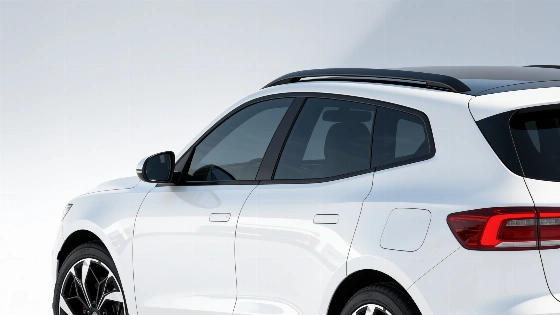
The SUV retains a 400V electrical architecture, information from the initial product information. The rear three-quarter image released ahead of the unveiling showed the revised rear section and a D-pillar treatment associated with the brand’s design language. The interior follows Polestar’s minimalist approach, with a 15.4-inch central touchscreen and a 10.2-inch digital instrument cluster.
Michael Lohscheller, Polestar’s chief executive, said the company had seen strong interest from customers seeking greater practicality alongside distinctive design and performance. “The Polestar 4 has quickly become a favorite among our customers, and we’ve seen strong interest from drivers looking for distinctive design and performance combined with greater practicality. With the Polestar 4 SUV, we’re building on that success by offering even more versatility without losing the essence of the Polestar 4.” Lohscheller also linked the vehicle to Polestar’s European growth strategy, describing the market as “somewhat flat” while saying orders were strong.
Production is underway at the Busan plant in South Korea, with European customer deliveries scheduled for the fourth quarter of 2026. The initial production batch comprises 5,000 vehicles intended for Europe. Polestar’s plan pairs the new body style with the existing Polestar 4 powertrain range; the reported batch size is equivalent to 34.8% of the company’s estimated global retail sales for the third quarter.
In a study conducted with the University of Oxford, Polestar reported that the 544-hp Performance version recorded up to 32% greater maximum acceleration than the rear-motor model, alongside 15% lower steering effort under the compared conditions. The company said lap times were nearly identical in the high-speed comparison, despite differences in acceleration and steering load. These findings concern measured driving-performance differences, not vehicle homologation or regulatory certification.
Several premium brands are expanding their electric-vehicle offerings. Porsche, for example, recently introduced a high-performance cabriolet variant of its iconic 911, as detailed in our coverage of the Porsche 911 GT3 S/C, reflecting the broader industry trend toward expanded model lineups.
Polestar’s SUV is aimed at buyers seeking everyday usability and range in a distinctive design. Its conventional glass hatch and larger luggage area distinguish it from the coupé, while the two powertrain options preserve a choice between maximum range and stronger acceleration as the model enters the European market.