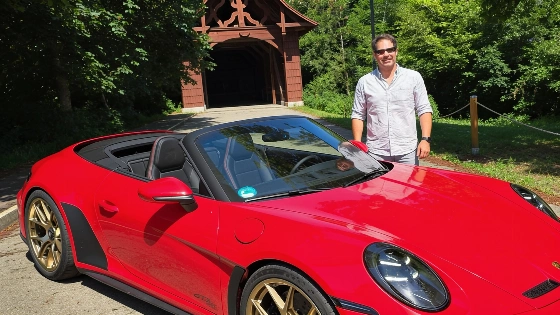
The Porsche 911 GT3 S/C debuts as the first GT3 cabriolet with a fabric roof, 510 hp, manual gearbox, and double wishbone suspension. Priced at over €312,000, it promises a raw, focused driving experience rarely seen in open-top sports cars.
With the roof folded and sunlight streaming across the dashboard, the Porsche 911 GT3 S/C immediately sets itself apart from typical convertibles. This is not a car designed for leisurely cruises along the marina. Instead, it is a thoroughbred GT3—now with an automatic fabric roof, a naturally aspirated engine that revs to 9,000 rpm, and a six-speed manual transmission, all engineered for drivers who crave connection over comfort.
The 4.0-liter flat-six engine is the heart of the experience. Its power delivery is urgent and linear, building to a metallic crescendo as the tachometer sweeps toward its 9,000 rpm redline. The sound is visceral, echoing off every surface and flooding the cabin, especially with the roof open. Unlike many modern sports cars, the GT3 S/C does not rely on turbocharged theatrics; its appeal lies in the purity of its response and the immediacy of its feedback.
Design and Materials
The exterior silhouette remains unmistakably 911, but with a tauter, more athletic stance. Measuring 4,570 mm long, 1,852 mm wide, and 1,279 mm high, with a 2,457 mm wheelbase, the GT3 S/C is both compact and purposeful. Matrix LED headlights clean up the front end, allowing for larger air intakes and improved aerodynamics.
Porsche’s relentless focus on weight reduction is evident throughout. The hood, fenders, and doors are crafted from carbon fiber, as are the anti-roll bars and structural chassis plate. Magnesium wheels—20 inches at the front, 21 at the rear—shod with Michelin Pilot Sport Cup 2 tires, save an additional nine kilograms. The fabric roof, built on a magnesium frame, opens or closes in just 12 seconds at speeds up to 50 km/h, preserving the coupe’s elegant lines even when closed.
Driver-Focused Interior
Inside, the GT3 S/C is stripped of distractions. It is strictly a two-seater, with standard Sports Plus seats and optional carbon fiber buckets for those seeking maximum support. The digital instrument cluster is minimalist, especially in Track Screen mode, which displays only essential data: tire pressures, oil, coolant, and fuel. Door pulls and panels are made from carbon fiber, underscoring the car’s obsession with saving weight without sacrificing quality.
The six-speed manual gearbox is the emotional core of the cabin. While it may not match the speed of Porsche’s PDK automatic, it demands more from the driver, rewarding precision and engagement. A rotary dial on the steering wheel allows for instant changes between driving modes, transforming the car’s character at a twist.
Performance and Chassis
Switching to Track mode and pushing the throttle to the floor, the GT3 S/C delivers 510 hp and 450 Nm of torque, launching from 0 to 100 km/h in 3.9 seconds and reaching a top speed of 313 km/h. The engine’s cylinder heads have been revised, and the camshafts are borrowed from the 911 GT3 RS, tuned for even more aggressive high-rev performance.
For the first time in a 911 cabriolet, Porsche has fitted a double wishbone front suspension, promising sharper, more precise handling. On winding roads, the front end responds instantly, with no hesitation or excess filtering. Standard PCCB carbon-ceramic brakes save over 20 kilograms compared to cast iron, delivering consistent stopping power and reduced unsprung mass.
Rather than compensating for the convertible roof with brute force, Porsche has focused on intelligent weight savings—carbon fiber, magnesium, and a lithium-ion battery that alone trims four kilograms. The result is a car that feels agile and alive, not just fast on paper.
While rivals like the Ferrari 296 GTS and McLaren Artura Spider may offer more outright speed or advanced technology, the GT3 S/C is about connection: steering, shifting, sound, and the raw sensation of a naturally aspirated engine. It is a car designed to linger in the memory long after the drive is over.
The price reflects its exclusivity: €312,556, with the optional Street Style package adding another €31,059. For those who value the analog thrill of driving above all else, the cost is part of the experience.
For enthusiasts tracking the evolution of performance convertibles, the arrival of the GT3 S/C echoes a broader trend toward blending classic driving engagement with modern engineering. This approach can also be seen in models like the latest Mazda MX-5, which faces its own crossroads as electrification reshapes the segment—a topic explored in depth in our recent look at the future of the iconic Miata.
As the automotive world accelerates toward electrification and digitalization, the Porsche 911 GT3 S/C stands as a rare celebration of mechanical purity. Its arrival marks a significant moment for those who believe that the essence of driving is best experienced with the wind in your hair and a manual gearbox at your fingertips.