A confidential police report claims Morocco's security forces coordinated the July mass entry into Ceuta. The document dismisses spontaneity and points to territorial motives. Most migrants returned to Morocco within hours.
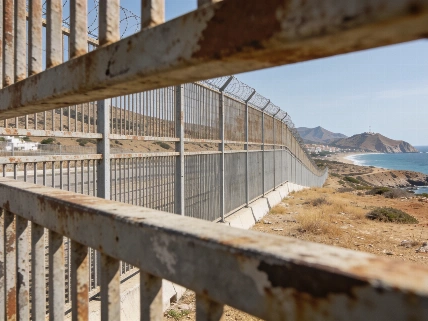
A classified report from Spain's National Police has concluded that the mass entry of migrants into Ceuta on July 30 and 31 was not a spontaneous event, but a coordinated operation led by Moroccan security forces. The document, sent to National Court judge María Tardón and the prosecutor's office, asserts that the migration was merely a formal cover for a broader political maneuver, with Moroccan agents—both in uniform and plainclothes—directing the flow of people across the border.
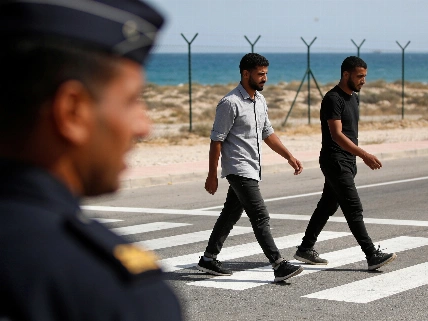
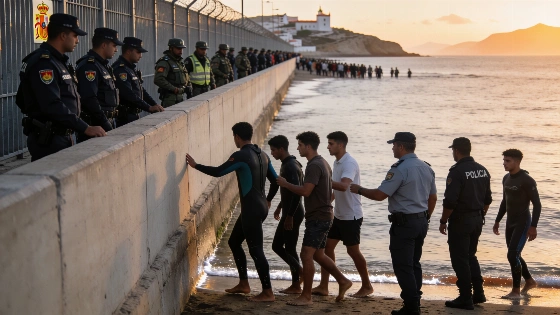
According to the report, the vast majority of the 72,000 migrants who crossed into Ceuta returned to Morocco within hours, undermining the idea that the incident was driven by genuine migration intent. The police analysis, based on images and intelligence from the Centro Nacional de Inmigración y Fronteras (CENIF), details how Moroccan gendarmes and plainclothes operatives actively guided groups to specific crossing points, including the El Tarajal breakwater. These individuals, some of whom were seen instructing uniformed officers, maintained control over the operation on the ground.
The report also highlights the organized nature of the entry, describing several waves of migrants with distinct profiles. Early on July 30, young Moroccan men equipped with wetsuits and flotation devices arrived first. Later, families, women, and children—mostly Moroccan, with some sub-Saharan Africans—crossed, many without swimming gear. A third wave, again dominated by young men, followed overnight. This sequence, the report argues, was designed to overwhelm Spanish border management, first with the most prepared individuals, then with more vulnerable groups once the system was saturated.
Spanish authorities had issued a high-risk alert for coordinated illegal entries by sea and over the fence the day before the incident. The CENIF report notes that a second attempted mass entry, planned for August 15, was fully controlled by Moroccan forces, in contrast to the July events. Following the July crossings, Moroccan officials publicly reiterated their territorial claims over Ceuta and Melilla, adding a political dimension to the crisis.
The police document further suggests that the operation had counter-intelligence effects, exposing weaknesses in Spain's intelligence services, particularly the CNI, in detecting the planned incursion. This assessment challenges the Spanish government's previous approach of cooperation with Morocco and provides grounds for further judicial investigation, as noted by legal sources cited in EL ESPAÑOL.
Judge Tardón, who was on duty during the incident, requested detailed reports from both the National Police and the Civil Guard to determine whether the events could constitute a crime against state independence, a matter under the National Court's jurisdiction. Prime Minister Pedro Sánchez initially described the episode as an attack on Spain's territorial integrity.
For additional context, similar tensions at the Ceuta border have previously led to public protests and calls for stricter measures, as reported in coverage of local demonstrations demanding migrant expulsions.
Ceuta and Melilla, Spain's enclaves on the North African coast, have long been focal points in migration and diplomatic disputes between Spain and Morocco. The July 2026 incident underscores the complexity of border management and the interplay between migration, security, and geopolitics in the region. The ongoing investigation may influence future Spanish policy on border security and bilateral relations with Morocco.