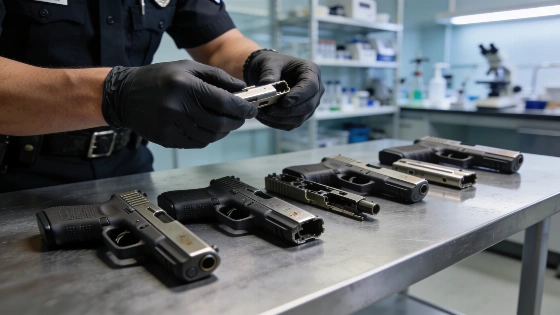
Spanish police have dismantled a large-scale operation producing fully counterfeit Glock pistols. Authorities say this is the first time they have intercepted such a volume of fake firearms ready for sale. The Mossos d'Esquadra, working with the National Police, seized 38 imitation Glocks in Barcelona, as low-cost, mass-produced weapons enter the black market.
Investigators describe the seized pistols as visually similar to authentic Glocks, but with clear differences in quality and safety. Police officials say the fake triggers require more force, and the weapons are prone to jamming or even exploding. Despite these flaws, the pistols were openly marketed among criminal circles, with traffickers sharing videos showing the weapons being handled and assembled. Some of the arsenal was found in a car parked on a residential street in Pla del Penedès, a small town near Barcelona.
The operation was allegedly led by Daniel Doya, who reportedly coordinated the network from prison, where he has been held since 2009. The group acted as brokers, supplying violent criminal groups, including members of the Trinitarios gang, with hybrid and fully fake Glock pistols. The counterfeit weapons were offered for €3,000 to €4,000 each, while their production cost was estimated at around €200. By contrast, a legal Glock in Spain typically costs about €800. Black-market prices can fluctuate dramatically, sometimes reaching €15,000 depending on demand.
Glock is an Austrian manufacturer whose basic pistol models include the Glock 17, 19, 26 and 45. The company’s handguns are polymer-framed, striker-fired pistols that use its Safe Action trigger system. These design features offer a general point of comparison for examining suspected copies. Investigators say differences in finish and engravings, along with details in the internal mechanisms, can reveal their counterfeit construction.
Police say the emergence of fully fake Glocks follows a crackdown on so-called “Grey Glocks,” hybrid pistols combining genuine and counterfeit parts. After Austria tightened controls on the sale of Glock frames, criminal networks shifted to manufacturing complete counterfeits. These new models lack serial numbers or other traceable features, making it nearly impossible for authorities to identify their origin. Investigations suggest Turkey may be a basic source, as the country is known for producing legal blank-firing guns as well as illicit firearm components.
The alleged production network sits within a wider Barcelona-area context in which imitation firearms have featured in criminal investigations. Ara has reported arrests in cases involving fake short firearms allegedly used to threaten robbery victims in Barcelona and L’Hospitalet de Llobregat. Those incidents involved replica weapons and do not describe the manufacture of functional counterfeit Glocks.
Mossos d'Esquadra experts say the fake pistols are easy to mistake for real ones, though differences in finish and engravings, as well as details in the internal mechanisms, reveal their true nature. Many buyers, but, believe they are purchasing genuine Glocks, increasing the risk of accidents and further complicating law enforcement efforts. The proliferation of these weapons could lead prices down and make firearms more accessible to a wider range of criminal groups.
The rise in counterfeit firearms comes amid broader concerns about security and illegal trade in Spain. Recent measures to tighten controls on large cash movements, as reported in a related article on new financial regulations, reflect authorities' efforts to disrupt criminal networks and limit their resources.
Spain's experience with counterfeit firearms illustrates the developing tactics of organized crime and the challenges facing law enforcement. The weapons' lack of traceability and ease of distribution make them particularly difficult to combat. Authorities are focused on preventing the spread of dangerous, unregulated firearms that could fuel further violence across the country.