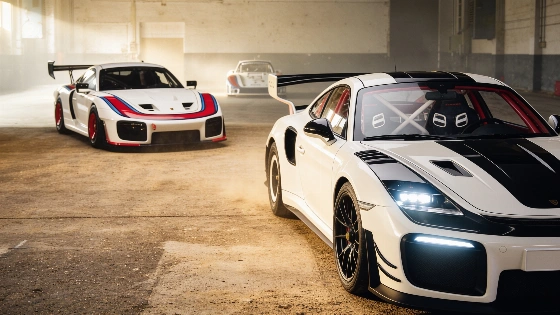
Porsche has created a one-off 911 GT2 RS inspired by the legendary 935 Flachbau, known as “Moby Dick.” Developed over nearly three years by the Sonderwunsch department and Manthey, the project produced a bespoke car that stands apart in automotive design. Porsche’s Sonderwunsch program is intended for commissions that go beyond a standard options list: the company says it lets customers customise vehicles “far beyond the standard configuration” and create unique, one-of-a-kind pieces.
The change began with a 2018 911 GT2 RS (991.2 generation) equipped with the Weissach package. Specialists across Style Porsche and Weissach development worked with Porsche Motorsport and Manthey to reshape the car’s bodywork, echoing the unmistakable lines of the 935/78 Le Mans racer. The result is a road-legal machine that fuses motorsport heritage with modern performance. The 935/78’s extended tail and aerodynamic wheel treatments informed the 2018 Porsche 935 reinterpretation, itself based on the 911 GT2 RS. That racing model used a twin-turbocharged 3.8-liter flat-six producing 700 hp. It paired the engine with a seven-speed PDK transmission and was limited to 77 examples.
Design was overseen by Grant Larson, whose previous work includes the modern reinterpretation of the Porsche 935 for the brand’s 70th anniversary. Porsche Motorsport’s then-vice president for Motorsport and GT Cars, Dr. Frank-Steffen Walliser, called that 935 “a birthday present from Porsche Motorsport to fans all over the world.” On this Flachbau RS, the front fenders sit notably lower, alongside slim LED headlights arranged in a stepped layout. The car is finished in Grand Prix White, a classic Porsche color first seen on the 911 in 1974. The shade was developed specifically for this project with reference to a historic model from the brand’s collection. Matte black accents and exposed carbon fiber add visual depth and technical flair.
Distinctive details set the car apart from a standard GT2 RS. The hood and roof feature inverted stripes, with a central U-shaped carbon fiber section reminiscent of the 935/78’s Martini livery. The rear wheels wear aerodynamic discs painted in Grand Prix White, while the brake calipers are black. The redesigned front wheel arches incorporate louvered vents to reduce internal pressure. Those changes required modifications to the fuel filler cap and its underlying mechanism.
Manthey has completely reworked the front bumper, adding subtle black elements. The package adds a new front splitter and the Manthey Kit’s lower structure. A rear diffuser joins carbon fiber aero discs at the back, helping minimize drag. The new S-shaped support wing draws inspiration from the 992-generation 911 GT3 R Rennsport and sits five centimeters higher than usual. Drivers can adjust it manually to three positions, tailoring downforce for track use.
In high- and low-downforce settings, rear axle load increases by 2% and 3%, respectively, compared with a standard GT2 RS with the Manthey Kit. At 340 km/h in high-downforce mode, the car generates 554 kg of rear downforce, a figure that reflects its track-focused setup.
Inside, the focus on weight reduction is clear. Red Alcantara and black leather remain up front, alongside carbon fiber, but the rear section has been almost entirely stripped. The Porsche Communication Management system and audio components have been removed, as has much of the sound insulation, saving 31.6 kg compared with the original vehicle. Grand Prix White-painted metal and visible wiring give the cabin an uncompromising character, reinforced by carbon trim. The carbon bucket seats are embroidered with “Flachbau RS” and a Nürburgring-Nordschleife outline. Gold plaques reading “Sonderwunsch” and “Factory One-Off 2026 | Flachbau RS” add a bespoke touch to the dashboard.
Porsche subjected the car to extensive validation, including digital crash simulations and airbag deployment tests. The company also conducted structural analysis and CFD-based aerodynamic calculations. Three test vehicles were built and evaluated in lighting and wind tunnels, as well as on public roads. Track testing took place at Mendig airfield, Nürburgring-Nordschleife, and Weissach.
The Flachbau RS is a true one-off, not a numbered limited edition. Road & Track has reported that Porsche was developing about 15 such individual projects, with projected prices ranging from just under $2 million to about $15 million. A separate Automobil.si report said the Flachbau RS had been sold and put the broader project range at €1.62 million to €13.47 million. Those figures are estimates for bespoke commissions, not a published transaction price for this car.
The project reflects a growing trend toward ultra-personalized supercars, as manufacturers tailor vehicles to individual visions through technical precision and historical design. Other recent collaborations include a unique Ferrari built for a private collector, detailed in this report on Ferrari's one-off CZ26. The world’s top automotive brands continue to push the boundaries of exclusivity and engineering.
For Porsche, the Flachbau RS brings together tradition and innovation, shaped by the client’s ambitions. It revives a legendary silhouette and sets a new benchmark for bespoke performance vehicles, blending the spirit of Le Mans with the demands of modern road use.