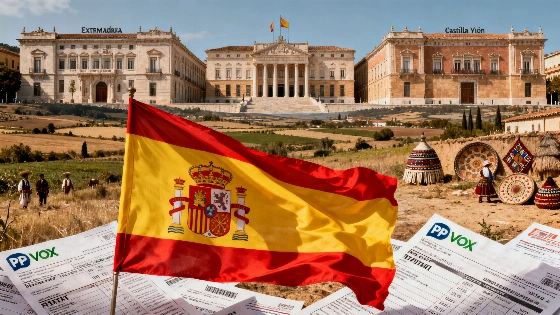
PP and Vox coalitions in Extremadura, Aragón and Castilla y León are rolling out a shared program. The focus is on tax relief, deregulation, and identity measures. Public disagreements are minimal as both parties consolidate power.
PP and Vox have moved quickly to implement a broad joint agenda in Extremadura, Aragón and Castilla y León, following their renewed coalition agreements in 2026. The two parties, now sharing power in these regions, are minimizing public disputes and focusing on a detailed program that covers economic, social and cultural policy. The approach marks a shift from campaign differentiation to coordinated governance, with each party managing its own areas and avoiding open conflict.
One of the most visible changes is a series of tax reductions targeting businesses and property. All three governments have prioritized lowering or eliminating taxes such as Inheritance and Donations, which both PP and Vox have long criticized. In Extremadura, these cuts are already reflected in the approved regional budget, with similar measures planned in Aragón and Castilla y León.
Environmental regulation is also being rolled back. Vox, leading ministries focused on deregulation, is pushing to shield rural sectors from EU Green Deal policies. Initiatives include scrapping or relaxing environmental protection laws, removing nuclear taxes in Extremadura, and adjusting or eliminating taxes on water and emissions in Aragón and Castilla y León. Expansion of irrigation and restrictions on renewable energy installations are also on the agenda.
Healthcare and education are seeing increased collaboration with the private sector. In Extremadura, the 2026 budget allocates over €30 million for surgeries and diagnostics outside the public health system, a significant rise from previous years. Aragón is preparing to extend private contracts in both healthcare and secondary education, aiming to reduce waiting lists and expand options for families.
Housing policy is shifting toward liberalization of land and a crackdown on illegal occupation. Extremadura and Castilla y León are moving to ease land-use restrictions, echoing earlier national reforms. These steps are presented as solutions to depopulation and housing shortages, with both parties emphasizing property rights and market-driven development.
On historical memory, the coalitions are replacing previous laws with new 'concord' legislation. In Castilla y León, a new law is set to recognize victims on both sides of the Civil War, while Extremadura has already enacted similar changes, removing references to dictatorship and coup from earlier statutes. In Aragón, the repeal of the memory law is on hold pending a Constitutional Court review, but the regional government has signaled it will not enforce the previous legislation.
Identity and cultural policies are a central theme. The three governments are moving to eliminate programs seen as diluting regional identity, such as Arabic language and Moroccan culture classes. Aragón plans to close the Catalan Language Institute, while Extremadura is launching a new cultural institute to promote what it calls an 'open identity.' Traditional and religious events, hunting, and rural customs are receiving increased funding and official support, with budgets for bullfighting and church restoration rising notably.
Natalist policies are being prioritized over direct challenges to abortion laws. The focus is on tax deductions and support plans for families, with new legislation in Extremadura and upcoming initiatives in Aragón and Castilla y León. Vox has not pressed for repeal of LGTBI laws, instead aligning with PP on measures to boost birth rates and support large families.
Financial support is being redirected. Aid for farmers, ranchers, and traditional sectors is increasing, while funding for unions, business associations, and organizations deemed to lack public utility is being cut. International cooperation budgets are being sharply reduced, especially in Extremadura and Aragón, where Vox-led ministries have already implemented significant cuts.
According to the original report, the alliance between PP and Vox is driven not only by tactical convenience but also by a substantial overlap in policy goals. While some differences remain, the current phase is marked by pragmatic cooperation and a shared commitment to reshaping regional governance. For context, these regions together represent a significant portion of Spain's rural population and have historically been testing grounds for national policy shifts. The developments in Extremadura, Aragón and Castilla y León may signal broader trends ahead of future national elections.