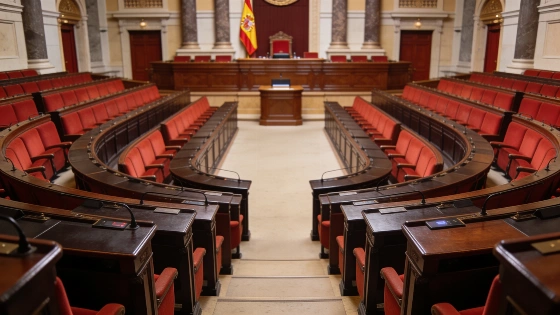
PP and Vox are discussing ways to coordinate their Senate candidates for the 29 November election. A three-fifths majority would let the right appoint four Constitutional Court judges without PSOE; no agreement has been announced.
Four Constitutional Court appointments are among the stakes in the Senate arithmetic now being discussed by PP and Vox. A three-fifths majority, at least 160 seats according to PP leader Alberto Núñez Feijóo, would also give the right leverage over key posts on the General Council of the Judiciary (CGPJ). The threshold would not automatically give either party sole control over every appointment, whose procedures depend on the relevant legal rules and appointing body.
The parties are aiming to pass the 160-seat threshold after the 29 November elections. On 19 and 20 October, Feijóo and Vox leader Santiago Abascal confirmed that they were discussing coordination. Their talks are still unresolved, and the options under consideration would change how candidates appear on Senate ballots in some constituencies. Abascal called for an understanding with the PP to protect the Senate from the PSOE’s pact with the left, while Feijóo said it would be a mistake to facilitate PSOE influence over the chamber.
The discussions have gathered pace amid the joint PSOE and Frente Amplio project, “Senado de Progreso,” which plans to field candidates in 45 constituencies. One proposal is for Vox to stand aside in a number of constituencies, possibly more than 20 according to voting simulations cited in the source material. Abascal has said he is prepared to make sacrifices, but the parties have not publicly settled whether Vox would withdraw entirely in selected provinces or limit its candidacy to one person in a constituency.
In most provincial Senate constituencies, voters can choose up to three candidates, while four senators are elected from each province. The ballot is candidate-based rather than a closed party list, so voters can select candidates from different parties. The parties are discussing coordination to avoid splitting right-wing votes. In return for Vox withdrawing candidates, the PP could offer the party senators appointed by regional parliaments after the May 2027 regional elections. The arrangement has not been settled.
Another possibility is for the PP to include a Vox figure among its candidates in selected districts, a “2+1” arrangement under which one of the three candidates a voter can select would be from Vox. The parties have also discussed whether Vox could receive additional regional Senate seats as compensation. People involved in the discussions have raised procedural and legal difficulties, since an agreement between parties would not itself create a joint Senate list. Vox is seeking guarantees that could help it form its own parliamentary group in the Senate.
The talks between the parties’ headquarters, known as Génova and Bambú, have continued for days. Both sides are trying to keep the details private and may wait until close to the filing deadline, midnight on Monday 26 October, to disclose any arrangement. The deadline for submitting coalition agreements was 16 October, but discussions over candidate coordination and withdrawals could continue within the election procedure. They want to limit the PSOE’s opportunity to respond.
The negotiations build on earlier reporting about their Senate list talks. The current discussion goes further by examining how Vox might be compensated if it withdraws candidates in selected constituencies.
Feijóo has said that Vox has five senators appointed by regional parliaments under agreements reached after recent elections. Those appointments differ from senators elected directly by voters: regional parliaments appoint senators according to the allocation of seats to each autonomous community and its parliamentary representation. Vox won no Senate seats through direct election in 2023. Its current regional representation has been linked to agreements in Extremadura, Aragón, Castile and León, and Andalusia.
For Vox, withdrawing from Senate contests altogether carries a political risk: voters often choose the same party for both chambers, and the move could affect its Congress result. The two parties have presented the effort as a way to keep the Senate from falling under PSOE influence. Abascal first called for sacrifices to protect the chamber; Feijóo later backed coordination, saying that if Vox met the challenge, the PP would do its part. Their cooperation has also become more visible in judicial and political matters, despite continuing differences.
Neither leader is scheduled to meet Javier Milei during the Argentine president’s visit to Madrid on Wednesday. Abascal told Milei by phone that he would be away campaigning, with a morning event in A Coruña before an afternoon stop in Avilés. Ignacio Garriga and Jorge Martín Frías are due to receive Milei at the Disenso foundation’s headquarters.