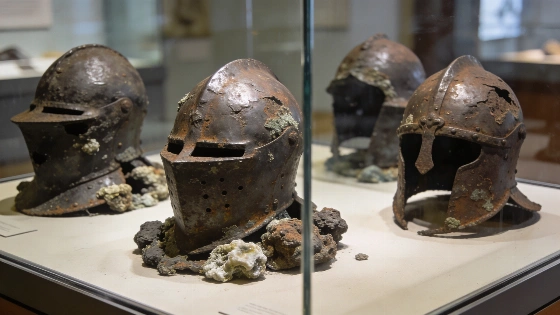
Largest Medieval Helmet Hoard Discovered in Castellón. A hoard of 43 medieval helmets has been found in the waters of Castellón. Research revealed they were made for protection against Turkish raids. The discovery changes current views on the region’s military history.
In Castellón, on the sea floor off the coast of Benicarló, archaeologists have discovered a unique treasure—43 iron helmets that, as it turned out, date back to the late Middle Ages. This is one of the largest finds of protective armor in Spain in recent decades. Initially, experts assumed these were Roman artifacts, but new laboratory analyses have completely changed the theory of their origin.
The study, published in the journal Antiquity, showed that the helmets were made for infantry between the third quarter of the 14th century and the early 15th century. Radiocarbon analysis of textile remnants preserved inside some of the items made it possible to precisely determine the era. According to researchers, the armor may have been intended for troops defending the Valencian coast from regular attacks by Turkish and North African pirates.
The discovery was actually made back in 1990 at a depth of six meters in the Piedras de la Barbeta area, where Roman amphorae and bronze items had previously been found. However, only now, after comprehensive analysis at the universities of Alicante, Valencia, and Granada, as well as in foreign laboratories, has it been possible to establish the true origin of the helmets. Most of the items were fused together by marine corrosion and calcareous deposits, which, according to researchers, played a key role in their preservation.
Experts note that the helmets were likely stored in a single cargo container or packed together when the vessel sank. This is supported by the fact that all items were found at one spot and form a uniform set. It is possible that the weapons were intended for local militias, mercenary units, or regular troops of the Kingdom of Valencia, who at that time were actively defending the coast from pirate raids.
According to Antiquity, the 14th–15th centuries were a time of constant military threats for the region. Since the mid-14th century, Valencia’s coastline was regularly subjected to attacks by Islamic pirates, and by the 1370s such raids had become systematic. This led to the construction of defensive towers, the fortification of settlements, and the formation of local garrisons. In these conditions, demand for lightweight, mass-produced weapons, including helmets, rose sharply.
Today, some of the discovered helmets are kept at the Benicarló City Museum and the Museu de Belles Arts de Castelló. The condition of the items varies: some are better preserved due to marine deposits, which created a microenvironment inside and even allowed fragments of inner padding to survive. Such finds are extremely rare for Spain and Europe in general.
Contextually, this discovery is a reminder of how historical artifacts can reshape perceptions of a region’s past. It is important to note that new findings regularly occur in Spain, which revise scientific interpretations. For example, recently in Colombia, one of the key politicians has passed away, which has also prompted a rethinking of historical processes.
For reference: the 14th–15th centuries in Europe were marked by major military conflicts, including the Hundred Years' War, while the Mediterranean remained a battleground between Christian and Muslim states. In Spain, it was during this period that the coastal defense system was being established, and military production was gradually moving toward standardization. The find in Castellón is a rare confirmation of how these processes affected daily life and the security of coastal territories.