A new laboratory at IES Aguas Vivas in Guadalajara will test construction materials made from waste. The project brings together 130 vocational students across six research lines.
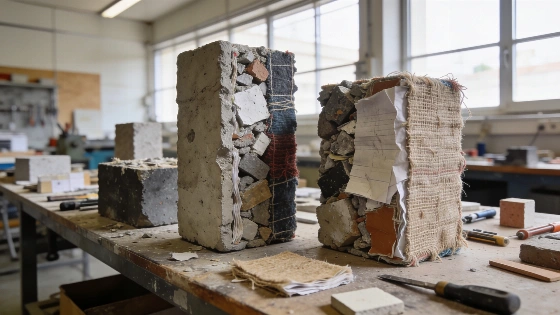
Construction waste will become the raw material for a new laboratory at IES Aguas Vivas in Guadalajara. The centre will involve 130 vocational training students in tests of recycled materials for future building uses. Six research lines will examine whether demolition waste, textiles, forest materials, paper, glass and other discarded products can be turned into workable construction solutions.
The initiative is called Laboratorio ReConstruye. It is planned as practical work, not just a classroom exercise. Students from different training levels will divide the tasks. Their work will cover design, research, manufacturing, assembly, execution and material preparation. The structure is meant to resemble a real company, with each group given a defined technical role.
CaixaBank Dualiza has opened registration for the La Básica en red congress for teachers of FP Grado Básico, scheduled for 6 November at CaixaForum Madrid. The event confirms the foundation’s current focus on basic vocational training and educational formats.
The most advanced students will lead design and research. Intermediate-level groups will handle manufacturing, assembly and implementation. Basic vocational training students will select, prepare and assess the materials. They will also suggest decorative uses.
The project began with Nora Marco Alario, who promoted the application to the Convocatoria de Ayudas de Caixa Bank Dualiza and is responsible for its development. IES Aguas Vivas is working with CEPA Río Sorbe, SIKA España and the Universidad de Alcalá to provide the laboratory's technical and educational framework.
Available search results do not independently confirm these project details or the stated partners. They should be checked against primary statements from the organizations involved.
The six work lines cover several possible products. One group will develop enclosure blocks from recycled materials. Another will test decorative acoustic panels made with reused paper and cardboard. A third will work on multilayer panels for lightweight enclosures, using textile fibres, vegetable fibres and other waste.
According to a CaixaBank Dualiza assessment cited in the vocational-training context, construction could generate 600,914 employment opportunities by 2035. Of these, 142,361, or 23.7%, would correspond to vocational-training profiles, highlighting the sector’s future demand for practically trained workers.
The remaining projects will focus on terrazzo made with recycled glass and stone fragments. Other groups will work on improved adobe and straw blocks that incorporate waste materials. They will also make decorative objects from cardboard, polystyrene or PVC residues.
The main test will be performance. The teams will run compression and energy-efficiency trials. The results will show whether the new materials meet present-day requirements, rather than simply copying traditional techniques. This matters especially for the adobe and straw products. The project aims to adapt those materials, not use them in their old form.
If the materials prove suitable for construction budgets, they could lower equipment costs and potentially affect the final price of housing. That is still a possibility to test, not an immediate result. The products may be presented at the Feria de FP de Guadalajara. The event is usually held in spring and is described in the project as one of the most important vocational training fairs in Spain.
The laboratory gives the school a direct way to connect vocational education with applied sustainability research and the circular economy. Those areas matter to construction because the project targets waste streams that would otherwise stay outside the production cycle.
Laboratorio ReConstruye will have to prove more than whether a recycled object looks good. Its materials will need to work in practice. That link between training and measurable performance is the project's strongest feature.