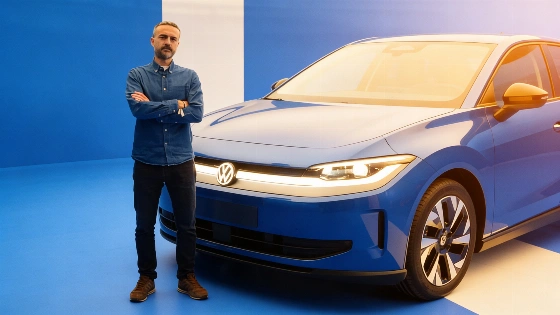
Renault has unveiled the 2026 Mégane E-Tech Electric, featuring a striking new design, a 67 kWh LFP battery for up to 500 km WLTP range, and rapid charging up to 165 kW. The model also debuts enhanced Google connectivity and practical features for daily use.
Renault has taken a decisive step forward with the 2026 Mégane E-Tech Electric, introducing a model that aims to stand out not just for its looks, but for its substance. The latest version arrives with a redesigned front end featuring 17 diamond-shaped elements, a more mature stance, and a suite of technical improvements that position it as a serious contender in the compact electric segment.
The new Mégane E-Tech Electric immediately draws attention with its bold front fascia. Renault has overhauled nearly every element except the headlights, giving the bumper more volume and lowering the brand’s logo to emphasize the car’s dynamic profile. The signature LED daytime running lights, now arranged as eight diamonds on each side, visually widen the car and add presence without resorting to gimmicks.
Dimensionally, the Mégane E-Tech Electric remains compact yet substantial, measuring 4.20 meters long, 1.78 meters wide, 1.52 meters high, and riding on a 2.68-meter wheelbase. Large 19- and 20-inch wheels, pronounced wheel arches, a high beltline, and flush door handles reinforce its modern, athletic look. At the rear, 3D taillights without external lenses and a more sculpted bumper give the car a fresher, more planted appearance.
Interior and Technology
Inside, Renault has focused on perceived quality and digital sophistication. The Techno trim features TEP dashboard coverings, while the Esprit Alpine version offers a sportier, more refined atmosphere. The openR system dominates the cabin, combining a 12.3-inch digital instrument cluster and a 12-inch multimedia display into a seamless, expansive interface—one of the best in its class.
Connectivity is a highlight, with openR link integrating Google services such as Google Maps, Google Assistant, Google Play (with over 100 apps), and Google Gemini for natural language interaction. While the abundance of tech is impressive, its real value will depend on how intuitively it can be used while driving.
Rear passengers benefit from 209 mm of knee room, a notable figure for this segment. The boot offers 440 liters of capacity (VDA), expanding to 1,332 liters with the rear seats folded—adequate, though not class-leading.
Performance and Battery
The most significant update lies beneath the floor: a new 67 kWh usable LFP battery, built with cell-to-pack architecture and Pouch 2 Cell technology using 232 cells. This upgrade enables the Mégane E-Tech Electric to achieve up to 500 km of WLTP range, making it a far more versatile option for drivers who split their time between city commutes and longer journeys.
Power comes from a 160 kW (220 hp) motor delivering 300 Nm of torque. The car accelerates from 0 to 100 km/h in 7.6 seconds, reaches 50 km/h in just 3.4 seconds, and tops out at 160 km/h. Charging performance has also improved: the Mégane now supports up to 165 kW DC fast charging, allowing a 15% to 80% charge in around 24 minutes. AC charging is available at 11 kW, with a 22 kW option.
Practicality is enhanced by a bidirectional charger with V2L (vehicle-to-load) capability, enabling the car to power external devices up to 3,700 W at 220 V—useful for work, leisure, or emergencies.
Driving Dynamics and Comfort
The Mégane E-Tech Electric continues to use the RG medium 1.0 platform, with the battery mounted under the floor and a multi-link rear suspension. Renault has revised the springs, dampers, and steering to maintain the car’s dynamic feel, despite a curb weight of 1,772 kg. The One Pedal driving function, combined with steering wheel paddles and four levels of regenerative braking, offers a tailored driving experience rather than a one-size-fits-all approach.
Trims, Equipment and Competition
The range has been simplified to two well-equipped trims: Techno and Esprit Alpine. The Techno version includes the openR display, integrated Google services, a heat pump, battery preconditioning, the 220 hp motor, and 19-inch wheels. Esprit Alpine adds 20-inch wheels, electric massage seats, a Harman Kardon audio system, and additional driver assistance features.
Against rivals like the Volkswagen ID.3, Cupra Born, Peugeot E-308, Kia EV3, and Hyundai Kona Electric, the Mégane E-Tech Electric now competes with a stronger battery, advanced Google-based technology, and a distinctive design. These updates make it a more compelling choice for buyers seeking a practical, connected, and stylish electric car.
With these changes, Renault signals its intent to remain at the forefront of the European electric compact market, offering a blend of everyday usability, advanced features, and a design that stands out without excess.