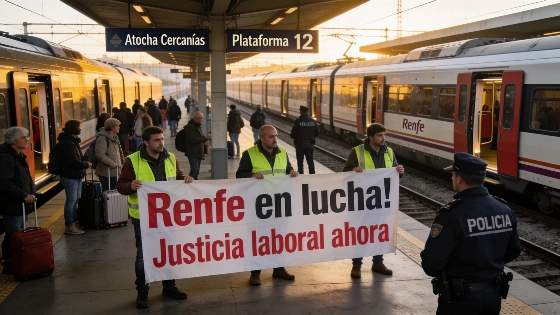
Renfe staff stage a new strike in protest against the sale of Renfe Mercancías and closure of maintenance bases. High-speed trains run at 73% minimum service. The dispute highlights growing unrest over Spain’s public rail system.
Rail services across Spain are facing renewed disruption as Renfe employees participate in a second day of strike action, called by Sindicato Ferroviario. The protest targets what the union describes as the ongoing dismantling of the public rail network, with particular focus on the planned sale of Renfe Mercancías and the closure of several maintenance facilities. The union accuses the Comisión Nacional de los Mercados y la Competencia (CNMC) of exerting undue pressure on the sector, claiming it favors private operators at the expense of public rail.
Wednesday’s strike has prompted the Ministry of Transport and Sustainable Mobility to impose minimum service levels, aiming to limit the impact on passengers. For high-speed and long-distance routes, 73% of scheduled trains—249 out of 343—are guaranteed to operate. The remaining 94 services depend on the level of participation in the strike. In the Cercanías commuter network, minimum services vary by time of day: 75% during peak hours and 50% at other times. Medium-distance trains are running at 66% of normal capacity, ensuring 426 out of 650 planned services.
Sindicato Ferroviario has also organized a demonstration at 11:30 a.m. outside Renfe’s Madrid offices in Atocha, denouncing what it calls the company’s “antidemocratic attitude.” The union’s statement criticizes Renfe’s management for presiding over what it sees as the most challenging period in the company’s history, citing layoffs during previous strikes, the privatization of Renfe Mercancías, and the closure of workshops. The union further alleges that Renfe has attempted to undermine strike action by not respecting minimum service agreements and by infringing on the right to strike.
Renfe, for its part, notes that the previous strike on June 29 saw only 1.83% participation, largely due to the lack of support from major unions. The company maintains that essential services are being preserved to minimize inconvenience for travelers. The current dispute reflects broader tensions within Spain’s public sector, as debates over privatization and labor rights intensify. Similar labor actions have recently affected other sectors, including education, as seen when the Catalan government urged teachers to reconsider a planned strike at the start of the school year—a situation detailed in this recent report on teacher strikes in Catalonia.
Spain’s rail system remains a critical part of national infrastructure, connecting major cities and regions. The outcome of the current standoff may influence future policy on public transport and labor relations. As the strike continues, passengers are advised to check schedules and prepare for possible delays or cancellations, especially on routes not covered by minimum service guarantees. The situation underscores the ongoing debate over the balance between public service obligations and market competition in Spain’s transport sector.