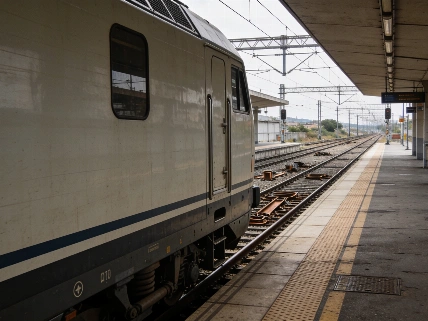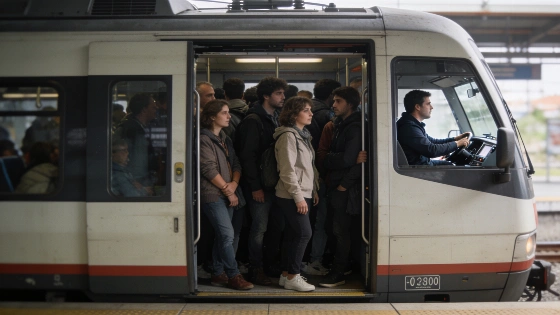
The R11 had left Barcelona-Sants at 20.16 after the 19.16 service was cancelled. By Sant Andreu, its aisles were packed with passengers, and the driver stopped the train before deciding to continue towards Figueres. The R11 runs from Barcelona-Sants to Portbou through Maçanet-Massanes, Girona and Figueres.
Rac1 first reported the incident, which took place on Saturday. A passenger account said the train was already nearly full at Passeig de Gràcia. At Sant Andreu, the driver asked passengers travelling beyond the station to leave and wait for an R2 Nord service that also ran as far as Maçanet-Massanes. He warned that the train would otherwise remain stopped.
Almost nobody got off. The driver then announced that the journey would continue, saying: “Recemos para que no pase nada” (“Let us pray nothing happens”, translated from Spanish). Some passengers applauded as the train moved again.
Renfe confirmed to EL PAÍS that it has opened an internal investigation to determine what happened and why the driver resumed the journey after warning that the train could not continue in those conditions. The company has not said whether disciplinary action is possible or identified a specific safety fault that prevented the train from travelling.
The inquiry comes amid a severe operational breakdown that began the week of 7 November and affected the R1, R2, R2 Nord, R2 Sud, R4 and regional services. Renfe attributed the disruption to an operational incident as the company and train drivers disputed working arrangements. The dispute followed the breakdown of long-standing agreements and the application of regulatory staffing schedules, which changed drivers’ reporting locations and daily service diagrams. Requiring some drivers to start shifts at Barcelona-Sants rather than intermediate stations contributed to crew shortages and service cancellations.
The scale of the disruption showed in Transporta’m’s operational log: on 11 November, only 102 of 310 scheduled Rodalies journeys ran, or 33% of the planned service. The R11 was also performing poorly in the days around the incident. On 13 November, its average delay was 22.8 minutes, 6% of services were cancelled and 16% ran on time. On 14 November, the average delay was 24.4 minutes, the cancellation rate was 9%, and only 17% of services were on time.
On Monday, R1 trains were running an average of 20 minutes late while drivers carried out brake tests. On the R4, one of the 20 trains running early in the morning was 40 minutes behind schedule; five others were delayed by about 15 minutes on average. The company said it was working to restore normal service as soon as possible.
Those delays followed a Friday agreement between Renfe and the drivers’ unions UGT, SMAF and CCOO on timetables, shifts and starting stations. The pact was intended to address organisational problems behind cancellations and delays during the previous week. It restored the earlier shift system and the option for drivers to start at intermediate stations rather than being required to report to Sants. It was due to take effect on Sunday, 15 November, with a gradual return to normal service. Renfe’s earlier timetable agreement is covered in this previous report.
Delays continued over the weekend after the agreement. At 10.00 on Saturday, 37 of the 74 trains operating in Catalonia were reported to be delayed; the R11 had the longest reported delay, at 58 minutes. A separate copper theft also affected railway operations, with delays reported on the R4, R2 Sud and R11, preventing a full return to normal service.
A strike is scheduled for Tuesday 17 November. The Generalitat has set minimum services at 66% during peak periods, from 6.00 to 9.30 and from 17.00 to 20.30, and 33% for the rest of the day.