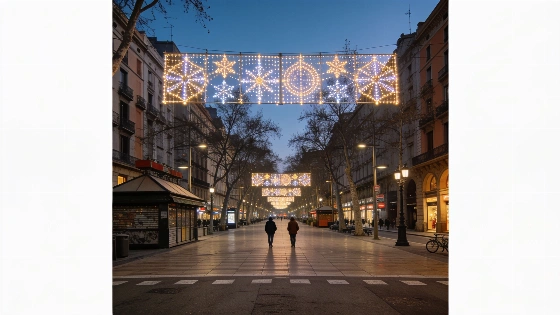
Barcelona’s Christmas lights will cover nearly 140 kilometres of streets across all ten districts from 26 November until 6 January. The programme has a reported budget of €4.6 million, with 65% financed through the city’s accommodation-related tourist tax, the Impost sobre les Estades en Establiments Turístics (IEET). In Sant Martí, the programme includes a new author-designed installation on the rambla de Prim. The citywide display is also reported to include 255 illuminated arches and 272 light figures. More than 50 decorated fountains are planned.
The launch is set for 17:00 on Thursday 26 November on the central stretch of the rambla, near Carrer de Llull. The Coral de la Fundació Vozes will perform. The event will open the district’s Christmas programme as the rest of the city’s lights are switched on. Barcelona City Council has scheduled simultaneous district-level switch-on events, and the lights are due to stay on through 6 January.
Hey Studio + Jorge Rivera (Neutral World) designed the display for the rambla de Prim. It is part of Barcelona Llums de Nadal, now in its second edition. The festival’s author-designed displays come from a creative competition organised by Barcelona City Council and ADI-FAD (Asociación de Diseño Industrial) to promote local talent and give the city a distinct visual identity. This year, the rambla de Prim and paseo de Maragall extend the approach beyond central streets that already had author-designed lighting. Passeig de Maragall crosses Horta-Guinardó and Sant Andreu; Jordi Canudes and Ingrid Picanyol are credited with its design.
Other installations will light up several neighbourhood sites. Windows at the Torre de les Aigües del Besòs will feature a proposal by Virginia Angulo, artistic director of Barcelona Llums de Nadal. The design draws on the central European Adventfenster tradition, where an illuminated window represents warmth and welcome.
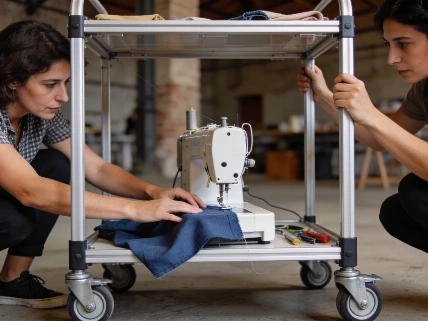
At the Mercat del Clot, the façade will retain a lighting proposal by La Invisible. The Mercat de Provençals is among 12 city markets where visitors can see the Galet by Ramon Bigas, revived as part of Barcelona’s creative lighting heritage. The Galet is also planned for Plaça del Rei and Rambla de Catalunya at the junction with Carrer de Provença. In Poblenou, design and architecture students will create shop-window displays for the Eix Comercial del Poblenou through Els Nadals il·luminen el comerç, an initiative by the Fundació Barcelona Centre de Disseny (BCD). Sant Martí’s community groups have also featured in coverage of local sewing collectives due to join the II Festival Món Filigranes.
The Port Olímpic will have a large light figure shaped like a gift at the end of the Balcó Gastronòmic. Eight illuminated Christmas trees are also planned, alongside special lighting for the Capitania building and the site’s palm trees. The lake at Nova Icària is included in the ornamental fountain programme. One of Barcelona’s 26 light structures will be installed on avenida de Icària.
Across the city, the lights will run from 17:30 to 01:00 from Sunday to Thursday. On Fridays and Saturdays, as well as the nights of 24, 25 and 31 December and 5 January, they will stay on until 02:00. The main city lighting ceremony is planned for passeig de Gràcia, with a large-scale stage and audiovisual production. Its programme also includes an original soundtrack and aerial dance.