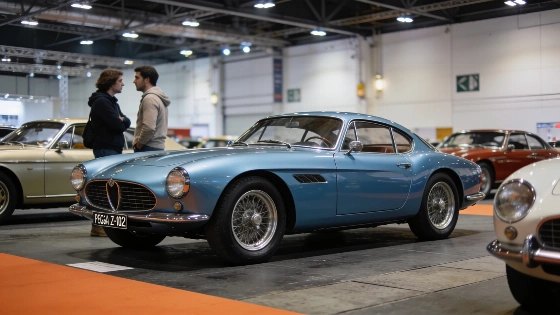
Retromóvil Madrid puts production of the Pegaso Z-102 at 86 cars, built by ENASA under the direction of Wifredo Ricart. Historical accounts also cite totals of 84 and 71. More than a dozen examples are due at IFEMA for the XXIII edition, giving the 75th-anniversary display a rare concentration of the Spanish sports car. The Z-102 made its public debut at the Paris Motor Show in October 1951; production continued until 1958.
Developed as a technological showcase for 1950s Spain, the Z-102 combined a lightweight-alloy V8 with four overhead camshafts and a De Dion rear axle. Its cars appeared in different configurations, with bodies by specialists including Italian coachbuilder Touring, French firm Saoutchik and Barcelona-based Serra, as well as ENASA. Two particularly rare exhibits are the Z-102 Barqueta Enasa Rabassada and the Z-102 Barqueta Pedralbes. The model also made its mark in competition: in 1953, Celso Fernández drove the Touring BS/2.8 barchetta at Jabbeke, Belgium, to a reported average speed of 243 km/h. That car was distinct from both a standard road-going Z-102 and the separate Bisiluro special associated with the Jabbeke story.
Ricart, who had worked at Alfa Romeo before returning to Spain, helped establish ENASA at the former Hispano-Suiza facilities in Barcelona. His grandson, José Ramón Ricart, will take part in the event alongside restoration specialist Michael Kempf. Portugal’s Museu do Caramulo is lending a Pegaso Z-102 B Touring Berlinetta. The museum will also bring an Abadal 25HP and a Hispano-Suiza H6B.
The Veteran Car Club España is bringing back the Concurso de Elegancia after a year away. It has confirmed 17 entrants across three categories: Prewar Cars covers vehicles made before 1945; Vestidos en España recognises Spanish-built bodies; Sport Cars is for sports cars from different periods.
The confirmed field ranges from a 1907 Jewell to a 1929 Rolls-Royce Phantom I. Spanish coachbuilding is represented by a SEAT 1400 Serra from 1956 and a Dodge Serra Boulevard from 1970. A 2002 Ford GT is among the later sports cars.
SEAT Sport’s 40th anniversary will be marked with three vehicles: a SEAT Córdoba WRC, a CUPRA GT and a replica of the SEAT Panda driven by Carlos Sainz in his early rally career. The Club Porsche España will mark 75 years of Porsche Motorsport with cars including a Porsche 356 SC and a 968 CS Cup. Its selection also includes a 964 RS Cup or RSR, a 911 3.0 RS and a 997 Cup R.
Other displays look beyond competition. Xuan de Lorenzo will present De Lorenzo Isósceles, his second hand-built car. Kobe Motor is collaborating on an exhibition for 75 years of the Toyota Land Cruiser, from its 1951 origins to current generations, with a gathering for owners and enthusiasts. The Club Saab España will mark 40 years of the Saab 900 Cabrio, first presented in 1986.
For a modern point of comparison, the latest registration update reported that Spain’s four-digit and three-letter sequence had reached NTX in data dated 3 November 2026.
Retromóvil Madrid runs at IFEMA from 11 to 13 December 2026. The programme also includes stands for parts, restoration and clubs, plus parking for visitors arriving in classic cars.