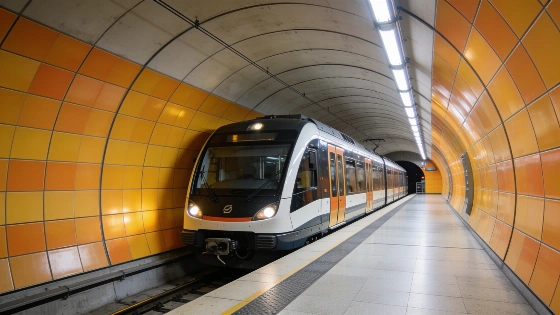
At 6.45am on 21 November, a train from Lasarte-Oria entered San Sebastián’s underground passage at Lugaritz and called at Benta Berri. It was the first service on the new route, which began carrying passengers that day.
The train then became the first to stop at Kontxa-Zentroa. A service from Pasaia inaugurated the underground Amara station at 6.47am. The three new stations, Amara, Kontxa-Zentroa and Bentaberri, are part of a 4.2-kilometre underground section.
The link runs beneath central San Sebastián, removing the former dead end at Amara and creating a continuous east-west route. Trains can now run at 7.5-minute intervals across the Añorga-Pasaia section, serving eleven stations with 276 daily circulations. The change extends those frequencies across Donostialdea for practically the whole week and improves weekend services across much of Gipuzkoa.
Passengers can use the new underground station at Amara, as well as the stops at Kontxa-Zentroa and Bentaberri. The stations provide access to the city centre, the La Concha area, El Antiguo and nearby university facilities, reducing the need for transfers previously made at the old Easo Square station. Earlier route details had outlined the planned change in train direction between Pasaia and Anoeta.
Overnight crews completed the connection to the existing railway at Morlans as scheduled, shifting the tracks laterally by 40 metres. The work also included changing the direction of travel between Pasaia and Anoeta, so trains would run on the left-hand side. New signals and audio and visual notices accompanied the change. Euskotren trained 197 drivers on the new infrastructure ahead of the opening, and several Series 980 trains were set to make their first passenger runs on the Topo.
The Basque Government’s Department of Sustainable Mobility said the line had begun operating normally after the overnight works. Minister Susana García Chueca thanked Euskal Trenbide Sarea, the railway infrastructure manager, and its contractors for the construction work. She also thanked Euskotren, the operator, for running the service.
The reopening brings the Topo back to central San Sebastián, 72 years after the city ended its operation through the centre in 1954. The service had originally reached the city centre by tram, running along central streets to a stop on Peñaflorida Street near Plaza Gipuzkoa. The new underground route replaces that street-running arrangement with through services beneath the city. The project took about nine years to build, with Orain reporting an investment of around €300 million.
The opening also brought art into the new underground spaces. The four shafts at Kontxa-Zentroa and Bentaberri feature ‘El eco de la bahía’, an installation by Víctor Goikoetxea. Artist Mikel Casal contributed work for the Kontxa-Zentroa staircases.