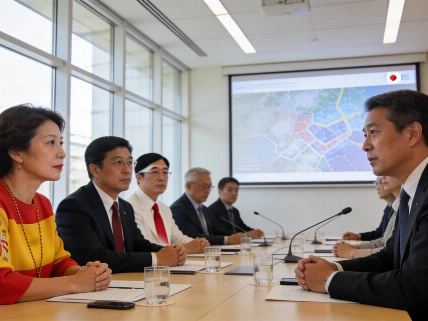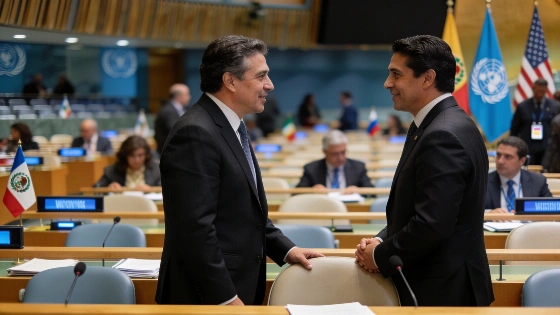
At the opening of the 81st United Nations General Assembly in New York, Pedro Sánchez and Delcy Rodríguez used their first face-to-face conversation to maintain direct contact on Venezuela. The Spanish prime minister told the Venezuelan acting president that Spain remains committed to Venezuela and the region's future. It was their first such conversation since Rodríguez replaced Nicolás Maduro as the country's leader.
Rodríguez approached Sánchez's seat to greet him and asked to continue discussing Venezuela's situation. Sánchez agreed and reaffirmed Spain's commitment to the future of the region, information from the Spanish Government. The exchange took place on 22 September 2026. No separate formal bilateral meeting between them was scheduled in New York. The Moncloa government's official agenda confirms Sánchez's presence in New York for the UN General Assembly programme.
The timing gave the encounter added diplomatic weight. Sánchez and Rodríguez spoke shortly before Donald Trump addressed the UN assembly. Their exchange took place in a high-level international setting, but it was not a formal bilateral meeting. Information from Moncloa, the message focused on Spain's commitment to the future of the region, not solely on a bilateral agenda.
Until then, Sánchez and Rodríguez had spoken twice by telephone. The first call took place on 9 January. Sánchez conveyed Spain's support for a peaceful transition to democracy through dialogue. Rodríguez proposed working together on a broad bilateral agenda intended to benefit both Spain and Venezuela.
A second call followed on 25 June after earthquakes struck Venezuela. Sánchez offered whatever assistance Spain could provide. He also expressed solidarity with the Venezuelan people and sympathy for the victims and their families.
The next possible point of contact could be Madrid. Rodríguez may travel to Spain in November for the Ibero-American Summit, scheduled for 4 and 5 November. Foreign Minister José Manuel Albares has already said Spain would invite her. The European Union still applies sanctions imposed when Rodríguez was Maduro's vice-president. Spanish reports published on 19 September 2026 described the invitation as a possible next step after the UN encounter.
The legal obstacle has not stopped every trip to European territory. After taking office, Rodríguez traveled to The Hague in May to appear in proceedings before the International Court of Justice involving Caracas and Guyana. The Netherlands granted special authorisation that temporarily suspended the travel ban for diplomatic or international obligations.
Changing European sanctions requires the unanimous approval of all 27 EU member states. Sánchez's government has asked for Rodríguez to be removed from the sanctions list. No decision to remove her from the list has been reported. Albares has described a possible visit to Spain as comparable to Rodríguez's earlier journey to the Netherlands.
The episode also comes alongside the domestic political disputes surrounding Sánchez that were reported earlier. The New York exchange itself concerns foreign policy, not Spain's internal debate.
Spain's position is clear. Madrid wants to keep talking with Venezuela and has backed Rodríguez's removal from the EU sanctions regime. The restrictions remain legally active. The New York encounter did not announce a new agreement or settle that dispute. It showed that Sánchez's government is keeping direct contact open and preparing for another possible meeting in Madrid if Rodríguez attends the Ibero-American Summit.