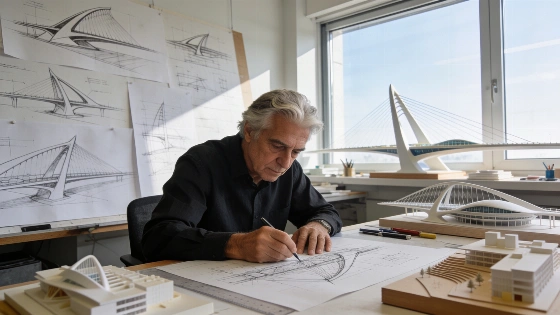
Santiago Calatrava, known for reshaping city skylines, credits his success not to sudden inspiration but to years of disciplined effort and experimentation. His journey from Valencia to global recognition reveals how persistence and technical curiosity shaped his most ambitious projects.
Santiago Calatrava’s career is defined by a refusal to believe in miracles. For the celebrated architect and engineer, every iconic structure is the result of years of drawing, technical research, and a relentless search for new solutions. In a recent conversation hosted by Fundación Arquia, Calatrava traced the decisions and setbacks that shaped his path from a young artist in Valencia to a global figure in architecture, engineering, sculpture, and drawing.
Born in 1951 in Benimàmet, near Valencia, Calatrava grew up surrounded by both urban life and the agricultural landscape of the huerta. This duality sparked an early fascination with form and construction. Although he initially dreamed of studying fine arts in Paris, the events of May 1968 forced him to change course. He began his artistic training in Valencia and graduated in architecture in 1974, before moving to Zurich to study civil engineering at ETH Zurich. His doctoral research on foldable structures in 1981 foreshadowed the blend of technical mastery and visual expression that would become his signature. That same year, he opened his own studio in Zurich, laying the foundation for a career built on integrating calculation, drawing, and observation.
Learning Through Experimentation
Calatrava’s earliest commissions already revealed his drive to experiment. Projects like the Wohlen Institute and the Ernsting warehouse doors became opportunities to test new construction methods. Each facade, he recalls, was a small-scale experiment, with every project informing the next. Rather than treating buildings as isolated results, he approached them as steps in a continuous process, asking concrete questions about movement, resistance, light, and spatial experience.
The Stadelhofen railway station in Zurich, completed in the 1980s, marked his international breakthrough. Bridges soon became central to his work, including the Bac de Roda in Barcelona, the Alamillo in Seville, and the Lusitania in Mérida. Calatrava sees bridges and stations as catalysts for urban development and local identity, a perspective that continues to influence debates on inclusive architecture.
From Valencia to the World
The 1990s expanded both the scale and ambition of Calatrava’s projects. The Lyon-Saint-Exupéry station combined expressive structure with dynamic spatial experience, while the Montjuïc Communications Tower, Bilbao Airport, and Tenerife Auditorium further showcased his sculptural approach. The City of Arts and Sciences in Valencia became his most recognizable ensemble, uniting public space, engineering, and artistic form.
Calatrava links these works to a period of transformation in Spain, from dictatorship to democracy. His international portfolio grew with the Milwaukee Art Museum, Malmö’s Turning Torso, and the Athens Olympic complex, followed by the Oculus at the World Trade Center and the St. Nicholas Greek Orthodox Church in New York. Despite the variety of scales and locations, his projects share a common thread: a structural investigation that turns technical challenges into lived experience.
Drawing, Patience, and Persistence
Architecture is only one facet of Calatrava’s creative life. Drawing, painting, sculpture, and reliefs have accompanied his projects from the beginning, serving as a laboratory for ideas rather than a separate pursuit. His artistic work has been exhibited at institutions such as the Metropolitan Museum of Art, MoMA, the Vatican Museums, and Palazzo Strozzi. Quoting Le Corbusier, Calatrava describes his approach as a “patient search.”
He rejects the myth of sudden inspiration, emphasizing instead a steady progression—one step, one building at a time. Each project builds on previous lessons but demands a new answer. As he puts it: “There are no miracles: there is work, there are drawings, and there is persistence.”
For those interested in exploring his legacy further, the Fundación Arquia’s digital film archive offers audiovisual content on architecture, including a dedicated feature on Santiago Calatrava.