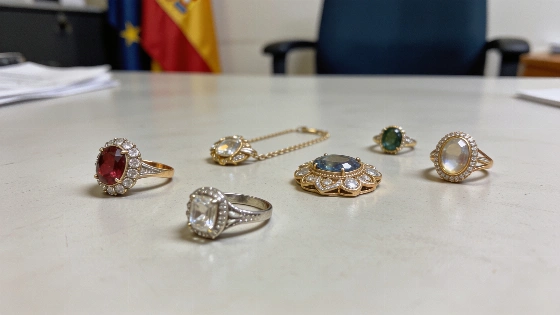
The three principal lots account for €938,500 of the seized jewellery, information from a 138-page report from Joyería Yanes. The firm puts the full collection at €1.02 million, below the €1.3 million valuation by Ansorena. The three lots comprise sets with necklaces and bracelets, plus rings and earrings. They feature rubies and emeralds, with sapphires also present; Zapatero’s defence said they represented more than 90% of the value of the jewellery found in his office.
The Yanes assessment challenges José Luis Rodríguez Zapatero’s account of the pieces’ origins. He has said the late Saudi king Abdalá Bin Abdulaziz Al-Saud gave them to him in June 2007 during an official visit to Spain and a stay at La Moncloa. The report says the most useful lots appear to have been made after 2007, though it cannot establish their exact production year. Police seized the jewellery during a search of Zapatero’s office on 19 May 2026.
Yanes bases that assessment on the lots’ low nickel content, which it says indicates they were not made before the 2007 REACH rules. The report also finds that the basic lots share the same metal and alloy, and appear to have used the same manufacturing technique and been produced at the same time.
The firm describes the jewellery as commercially made and probably of Asian origin. It says the pieces lack a maker’s signature and the identification marks associated with high-end jewellery. The report also points to missing certificates and original cases. It considers those omissions inconsistent with the usual presentation of expensive jewellery, while acknowledging that it cannot name a specific country of manufacture.
Judge José Luis Calama had already questioned the absence of original cases and documents showing authenticity or provenance. On 27 October 2026, the National Court investigating magistrate rejected Zapatero’s request for a rogatory commission to Saudi Arabia seeking confirmation that King Abdullah had given him the jewellery. Calama said the decision did not shift the burden of proof to Zapatero. He rejected the request because its underlying factual hypothesis lacked a minimum objective element of corroboration to establish its usefulness and necessity; he also found it related to the topic to the inquiry. The judge noted that no documents showed that two communications sent through the Saudi Embassy in Madrid had reached the Saudi Royal Court’s Protocol Office. Yanes was selected by the judge for the second appraisal; Zapatero tried to have the firm recused.
On the same date, Spain’s Directorate-General for State Patrimony sent the court a list of gifts received by Zapatero while he was prime minister. The list did not include some of the jewellery he says came from the Saudi monarch. The ruling did not determine the pieces’ provenance or ownership, and Calama left their final valuation to the expert assessment.
The appraisal is part of a separate line of investigation opened after Ansorena’s valuation. Calama has attributed tax offences and smuggling to Zapatero, alongside the alleged influence-peddling at the centre of the Plus Ultra case. The Fiscalía Anticorrupción has also asked for an embezzlement offence to be added. This jewellery inquiry is separate from the Asturian family's reimbursement claim over eight trips to Madrid for a baby's eye surgery.