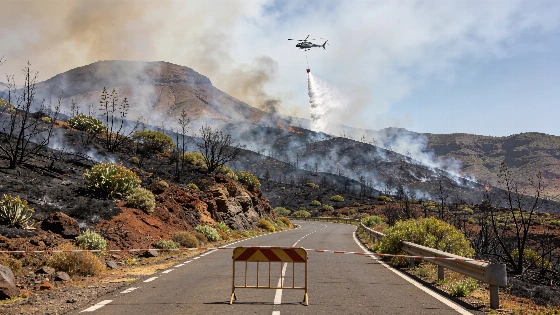
The wildfire that broke out last Thursday in Segorbe, Castellón, was declared stabilized by the Consorcio Provincial de Bomberos de Castellón at 7:30 a.m. on Sunday, after emergency crews worked through the night. The fire began after a lightning strike, forcing more than 1,000 residents of nearby Gátova to evacuate. It burned 630 hectares of forest in the Sierra Calderona, a protected natural area spanning Valencia and Castellón provinces.
Throughout the night, six units and six fire engines from the Servicio de Bomberos Forestales de la Generalitat Valenciana worked alongside four specialized wildfire units from the Consorcio Provincial de Bomberos de Castellón. Four forest brigades from the Consorcio Provincial de Bomberos de Valencia also joined the effort to bring the situation under control. Their coordinated response helped prevent further spread and damage across the natural park’s forest and scrubland.
After the fire was stabilized, the Centro de Coordinación de Emergencias deactivated the SPEIS protocol, which coordinates fire prevention and rescue services. The Unidad Militar de Emergencias (UME), mobilized to support firefighting efforts, was also stood down. The return to normal access happened gradually: coverage on August 22 described the fire as contained, but Gátova residents still could not return. On August 23, journalist Pablo Plaza reported for eldia.es that the situation had become “very favorable” and residents could go home. That change reduced the immediate danger, but did not establish that all emergency operations had ended.
The blaze unfolded during a severe wildfire season in Spain. European Commission Copernicus figures reported by Europa Press put the country’s burned area at 301,413 hectares from January 1 to October 21, 2026, equal to 43% of the European Union total. EFE Verde separately reported 275,209 hectares of forest burned by September 20, or 2.5 times the 2016-2025 average. These are national totals with different reporting cutoffs, not estimates for the Segorbe fire, whose reported area was 630 hectares.
The incident highlights wildfire risks in Spain’s Mediterranean regions, where dry spells and storms can complicate containment. Terrain and vegetation also make coordinated ground and aerial operations impressive. Other parts of the country have faced similar challenges, as seen when firefighters in Castilla y León struggled with staff shortages and equipment issues during record wildfire seasons.
Wildfires remain a impressive threat to rural communities and protected natural areas across Spain. The Sierra Calderona’s forests and scrubland form part of a field with high ecological value, so fires can have consequences beyond the immediate risk to nearby residents. The Segorbe response shows both the vulnerability of these areas and the importance of emergency coordination and a cautious, staged return home.