Two separate crashes in Castellón and Málaga in the early hours of Sunday, 28 June 2026, left seven people dead and eight injured. Emergency services worked for hours at both scenes, where multiple vehicles and complex rescue operations were involved.
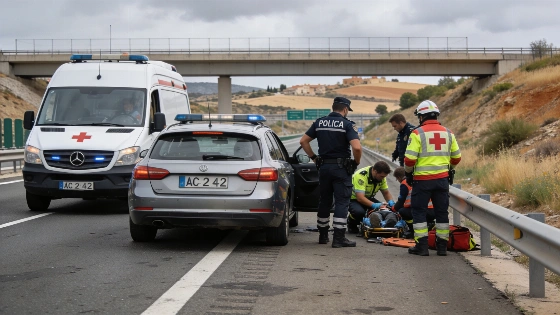
The most severe crash took place on the N-340 at kilometre 981, within the municipality of Castellón. The Levante Traffic Management Center reported that several vehicles were involved and that the collision was reported at 2:20 a.m. Medical teams included two SAMU units and two Basic Life Support (SVB) units; an Advanced Nursing Life Support (SVAE) unit also responded. Four people, three men and one woman, were pronounced dead at the scene. Six men were injured: three suffered multiple trauma injuries, while the others sustained contusions of varying severity. Firefighters carried out extrication operations for approximately five hours. Local police managed traffic, which was fully restored at around 8 a.m., while the Guardia Civil investigated the circumstances of the crash.
The N-340 is a major conventional coastal route through Castellón and has been the subject of road-safety debate. Castellón Información previously reported a claim by PSOE representative Santiago Pérez that three of Spain’s 15 identified “black spots” were in the province, and that the N-340 corridor between Torreblanca and Vinaròs had drawn repeated safety criticism. That discussion concerned the corridor and does not establish a connection to the collision at kilometre 981. It has also focused attention on traffic volumes and road design, with junction safety and the relationship between the N-340 and the AP-7 part of the debate.
In Málaga, a collision on the A-7 near the Cerrado de Calderón area led to three more deaths. It occurred at 2:38 a.m. at kilometre 979, in the direction of Almería, and involved two cars. One vehicle plunged approximately 30 metres down a ravine and came to rest on Pintor Sánchez Cotán street. Emergency services from 061 confirmed the deaths of two women and a man. Two people were injured: a 64-year-old woman was treated at the scene, and a 35-year-old man was taken to the Regional Hospital of Málaga. Firefighters freed trapped occupants, while local police and the Guardia Civil secured the area and assisted with the rescue.
Authorities in Málaga also reported finding a 60-year-old motorcyclist who had gone missing the previous day. His vehicle was found off the A-7000 near Los Montes de Málaga Natural Park, and firefighters recovered his body a few metres below. This was a separate fatal incident on Spanish roads that night.
The Dirección General de Tráfico’s Revista Tráfico y Seguridad Vial reported that 27 people died in 26 traffic crashes during Spain’s 2025 Semana Santa travel period, including eight motorcyclists. The national holiday-period figure provides a separate measure of road deaths and is not directly comparable with the toll from the two June crashes.
The incidents come amid continuing road-safety concerns in Spain, where traffic fatalities have fluctuated in recent years despite public campaigns and enforcement measures. Responses to major crashes require coordination among medical and fire crews, with law enforcement. Other recent emergencies, including the heatwave that claimed more than a hundred lives in three days, have also tested Spain’s emergency infrastructure, as detailed in coverage of the deadly June heatwave. The crashes show the risks on the country’s roads and the challenge authorities face in improving safety and emergency response.