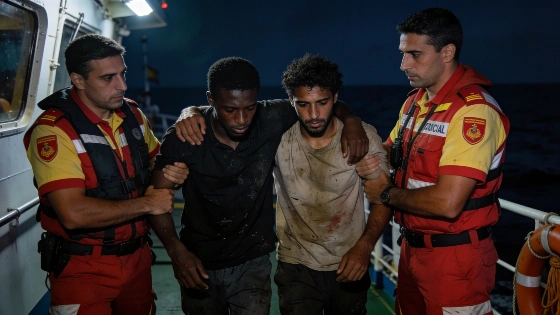
A 15-day drift across the Mediterranean ended with the deaths of 17 migrants trying to reach the Balearic Islands. The tragedy came to light when two survivors, both of North African origin, were rescued by the Guardia Civil about 12 miles southwest of Mallorca in the early hours of Tuesday, 4 August. The vessel had left North Africa carrying 19 people; only two were rescued.
Authorities said the survivors were found in critical condition, suffering from severe dehydration and malnutrition. Both were transferred to Son Espases Hospital in Palma, where their condition was later reported as stable. They told rescuers that the other passengers died one by one as the days passed without rescue. During the ordeal, their bodies were thrown into the sea.
The Rosalind Franklin ferry, operated by Baleària, raised the alarm after spotting the drifting boat while travelling between Barcelona and Algeria. Salvamento Marítimo sent the Helimer rescue craft to search the surrounding area, but found no additional survivors or bodies. The incident highlights the dangers migrants face when crossing the Mediterranean in small, overcrowded boats, especially when vessels remain at sea for days without rescue.
Balearic Islands President Marga Prohens expressed sorrow over the deaths and criticized Prime Minister Pedro Sánchez for what she described as a failure to recognize the migration pressures facing the islands. She pointed to nearly 100 arrivals in less than 24 hours and a reported 17% rise in recent days. Prohens called for stronger border controls and the activation of Frontex, while urging a more proactive migration policy. In later remarks reported in October, she described the pressure on the islands by saying, “There isn’t room for everyone here.”
In a separate incident, 15 more migrants were rescued about 30 miles southwest of Ibiza early the same morning. The rescues came amid sustained maritime arrivals in the Balearics. Spanish Interior Ministry figures for 1 January to 15 October 2026 put arrivals by sea at 6,741 people on 372 boats, compared with 6,104 people on 330 boats during the same period in 2025. That represents an increase of 10.4% in arrivals and 12.7% in boats. These figures cover the wider period, rather than the short-term rise Prohens cited.
Algeria is identified as a principal departure country for journeys towards the Balearic Islands and mainland Spain, part of a broader western Mediterranean movement. Frontex figures reported for the first nine months of 2026 recorded about 18,300 irregular border detections on the western Mediterranean route, while sea arrivals there rose by 8%. Across the European Union, irregular crossings fell by almost one-third over the same period. The events off Mallorca and Ibiza show the continuing humanitarian risks of these crossings and the demands they place on Spanish rescue and reception services.