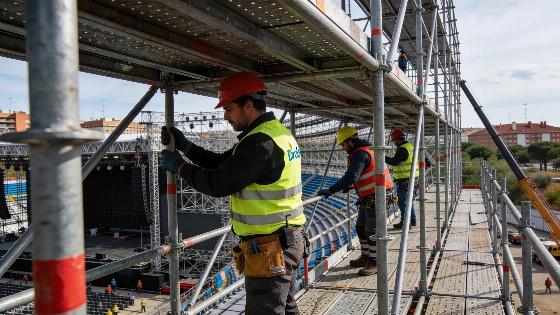
Construction is under way at Madrid's Iberdrola Music venue in Villaverde, where crews are assembling a temporary stadium for Shakira's planned 12-concert residency. The venue was expected to be ready just days before the first show on 18 September, with room for up to 50,000 people per night. The project formed part of the Las Mujeres Ya No Lloran World Tour and was billed as its only European stop. Organisers opted to build a venue for the occasion rather than use an existing stadium. Architectural publication Arquitectura Viva described the initial plan as 12 shows over six consecutive weekends, with the stadium designed by Bjarke Ingels Group (BIG).
The project’s centrepiece is 'Mundo Macondo', a themed area inspired by the magical realism of 'Cien años de Soledad' by Gabriel García Márquez. The wider site, named Macondo Park, covers about 185,000 square metres. Eight colour-coded pavilions will lead visitors through areas devoted to gastronomy and music, with separate spaces for art and literature. They converge on a central plaza marked by a symbolic macondo tree. The food zone will feature food trucks and communal dining, while the fashion area will showcase clothing and jewellery from Latin brands. The design extends the site beyond the concerts, with facilities for dining and shopping alongside cultural and leisure spaces.
Beyond standard merchandise, the fan zone will display iconic outfits Shakira wore in her music videos, while the literature pavilion will recreate the singer's personal home library. That space is planned for construction after the Coca Cola Music Experience festival, scheduled for 4 and 5 September, vacates part of the venue. A dedicated children's area called 'Macondito' is also planned.
To manage crowds and limit disruption, organisers have introduced measures including controlled exits after each concert and permission for attendees to remain on site until 1 a.m., although performances will end by 11 p.m. Noise levels and crowd flow will be closely monitored to avoid disturbances in surrounding neighbourhoods. Six modular grandstands will surround the basic stage, allowing organisers to adjust the layout and maximise capacity.
The original 12-show plan was later extended by a 13th performance. The residency ran from 18 September to 12 October 2026, drawing more than 700,000 people across the run, information from Music Business Worldwide. Live Nation Spain produced the residency. Attendance across the repeated concerts far exceeded the temporary stadium's capacity of more than 50,000 per night. The final event was billed as “12+1. The Day of Latinidad,” and separate reporting estimated the residency's economic impact at about €200 million.
Madrid's regional councillor for Culture, Tourism and Sport, Mariano de Paco, said the residency had proceeded “in complete normality” and described pedestrian movement as “perfect,” as reported by Europa Press. More than 225,000 people used public transport to attend the concerts. Metro de Madrid recorded nearly 192,000 entries across the 13 concert days, about 15,000 per concert day.
Madrid's approach to large-scale cultural events has drawn attention in recent years as the city balances tourism and local interests with the logistics of hosting major gatherings. The challenge of managing high visitor numbers and complex event infrastructure has parallels elsewhere in Spain. In Santiago de Compostela, for example, the influx of pilgrims has prompted debate about urban life and tourism, as discussed in this recent report on local tensions during the pilgrimage season.
Shakira's residency combined performances with cultural programming, all within a purpose-built visitor environment. That approach reflects a broader live entertainment trend toward immersive events. Its scale, from a temporary stadium designed for more than 50,000 spectators to a 185,000-square-metre themed site, also showed the logistical demands of drawing hundreds of thousands of visitors to a multi-date event.