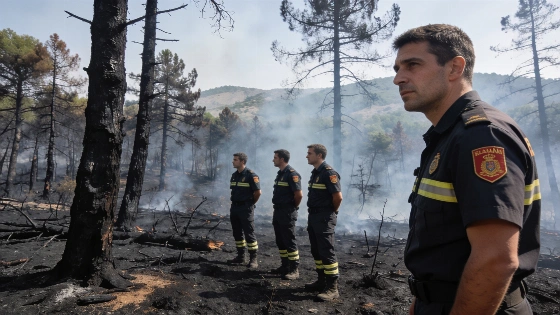
Firefighters spent ten days battling the wildfire that erupted in La Vall d’Uixó on 25 July and devastated a large section of the Sierra de Espadán. The Consorcio Provincial de Bomberos de Castellón said the fire was contained at 22:00 on Tuesday, a basic key stage for the region. It burned 9,568 hectares; later reporting described the affected area as nearly 10,000 hectares. The blaze became the third-largest wildfire in the Valencian Community in the previous decade.
Fire crews worked around the clock to keep the flames from breaching established control lines. Their efforts halted the fire’s advance, in line with emergency services’ forecasts of containment between Monday and Tuesday. Multiple agencies coordinated the operation, concentrating resources on the most active fronts and protecting the park’s most vulnerable areas. The emergency also involved evacuations of approximately 16,000 people from 18 municipalities.
Although the immediate threat subsided, the fire’s aftermath raised serious environmental and economic concerns for local communities. The Sierra de Espadán is a basic natural reserve in Castellón province, and the loss of such a large area will have lasting effects on biodiversity and tourism. The Guardia Civil, through its Servicio de Protección de la Naturaleza, investigated the fire’s origins. By October, RTVE reported that authorities had confirmed the fire was intentional, while investigators continued trying to identify the person responsible. Confirmation of the cause did not establish who set the fire.
The ecological damage extended beyond vegetation loss. The fire affected habitat and territories used by Bonelli’s eagle, and two nests destroyed by the blaze were later reconstructed as part of recovery measures led by the Generalitat Valenciana. The work was part of a broader effort to restore affected territories. The park’s cork oak forests and diverse wildlife make recovery a long-term challenge.
Wildfires have become an increasingly frequent challenge in Spain’s Mediterranean regions, often prompting access restrictions and emergency alerts. A recent incident in the Pyrenees, for example, forced authorities to block mountain routes near Senet, as detailed in this report on emergency closures in Vilaller and surrounding valleys. Such incidents expose the vulnerability of Spain’s natural landscapes to fire, especially during periods of high temperatures and drought.
The Sierra de Espadán fire unfolded amid an exceptionally severe wildfire season across Spain. Figures from MITECO cited by Europa Press recorded 280,079 hectares burned in 8,635 incidents through 4 October 2026, 140% above the decade average but 14% below the corresponding total for 2025. A separate Copernicus-based estimate put Spain’s burned area at 301,413 hectares through 21 October, or 43% of the European Union total. Those national figures provide context for the fire’s scale; estimates for the Sierra de Espadán itself ranged from approximately 9,600 to 10,000 hectares.
The fire highlighted the importance of rapid response and coordination among emergency services. Attention has turned to recovery and the long-term restoration of affected ecosystems, along with prevention strategies to protect Spain’s natural heritage. Authorities and conservation teams must restore damaged habitats as communities assess the effects on local livelihoods and tourism.