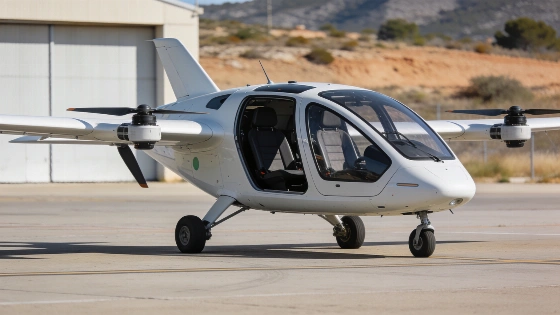
Ehang said its pilotless electric aircraft was operating in 40 zones in China when it appeared at Smart City Expo. The two-seat eVTOL has a range of 30 kilometres, or 15 to 20 minutes depending on its load. The EH216-S received a type certificate from China’s Civil Aviation Administration of China (CAAC) in October 2023, followed by a production certificate in April 2024. EHang later reported that it had also obtained a standard airworthiness certificate for the aircraft.
The company says the aircraft is remotely piloted and has local permits. Ricardo Ortega, Ehang’s vice-president for Europe, said its base is at Alguaire airport in Lleida. The company sees potential in aerial tourism and point-to-point journeys. Ortega also cited access to hard-to-reach areas during emergencies. In China, EHang’s commercial passenger operations reportedly began in March 2025, after the aircraft’s certification sequence and operational approvals. Chinese certificates do not themselves authorize passenger flights in other countries, where local authorities determine certification and operating approvals, including safety assessments.
Other exhibits focused on city services. Chinese firm Aimoga showed four robot models, among them a security robot that rides a scooter and is dressed as an urban traffic officer. It can direct traffic at junctions and check whether cars are parked correctly. It can also guide groups in public spaces.
The robot uses positioning and navigation technology alongside image recognition, and can operate for two hours. Aimoga representative Jiang Donglei said it was already on the streets of Wuhu, in Anhui province. The company also presented a nurse robot with a large screen on its torso, designed to help with patient triage and movement around hospitals.
Street lighting was another practical focus. French company Fonroche’s solar lamp works without cables and can be controlled remotely, removing the need to dig trenches during installation. The design also eliminates copper cable that could otherwise be stolen. Fonroche’s Spanish director, Yoann Beguin, said installations had been made at campsites and in Alcorcón and Seville. The company was in talks with the councils of Valencia and Huelva.
Fonroche had also been shortlisted in a competition to supply 14,000 larger, more powerful lamps for the 2028 Los Angeles Olympics. That selection did not amount to a confirmed contract.
Several displays focused on traffic monitoring. South Korean city Seongnam presented patrol robots made by Neubility, which have operated since 2025 in station squares and parks. Using image recognition, they can detect incidents such as fires or people who have collapsed, then alert a control centre and issue emergency warnings.
Kazakh company Noise Locator showed an AI traffic camera that uses microphones to locate excessively noisy vehicles, identify their registration plates and detect offences. A separate emissions monitor developed by Daver, a project of EIT Urban Mobility, measures nitrogen oxides and particles, along with carbon monoxide, hydrocarbons and ammonia as vehicles pass. The process takes less than a second and does not require vehicles to stop.
The exhibits also showed how dementia can affect movement through public spaces. At University College London’s Person-Environment-Activity Research Laboratory (PEARL), a 4,000-square-metre facility in Dagenham, researchers can recreate places such as streets and stations at full scale. The Smart City Expo demonstration simulated a pedestrian crossing from the perspective of someone with dementia affecting visual perception. Urban planners could then examine the difficulties faced by an ageing population.
Barcelona City Council and Fira, with the participation of Fundació Mobile World Capital, selected Kapsch and Acisa to test artificial intelligence in traffic-light management. Each company received €100,000 for pilot projects. Barcelona transport operator TMB presented a tool that assesses bus speeds and identifies routes where action could improve commercial speed. Municipal company BSM showed a model of Endolla Barcelona’s planned ultra-fast car-charging hub.