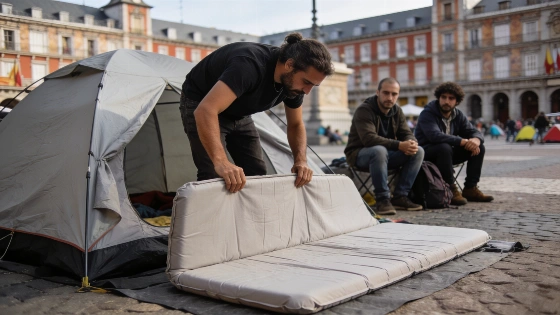
The camp’s organising system was already coming apart when a manifesto from the faction favouring continued protest left the central question unanswered: would the people at the site stay or leave? After more than a month in Puerta del Sol, the encampment was entering a period of reorganisation rather than an uncontested dissolution.
Representatives of that faction called for “resistencia” and proposed another way to organise the protest: “autogestión”, or self-management. Participants who rejected the camp’s dissolution announced an internal restructuring and said they would remain, while the manifesto did not clarify whether all the campers would stay in Puerta del Sol. The larger movement’s organisers, meanwhile, were moving most activity to Madrid’s neighbourhoods.
Housing had brought the protesters to Madrid’s kilometre zero. Their stated focus was now more specifically the rights of people without resources, who had become the majority of those camping there. An “Asociación de personas sin hogar” was also being organised, with its own structure and political aims, separate from the reorganised Acampada 26S. The movement’s continuing programme included opposition to evictions and a demand that Article 47 of the Spanish Constitution, which recognises the right to decent housing, become binding.
The change followed the departure of the commissions that had handled the camp’s logistics. They began leaving at the end of October, after the encampment had lasted more than a month, with the announcement made on Saturday. Seven of the ten commissions sustaining the settlement reportedly decided to leave; two founding commissions and groups including the communication team, “Pulmón”, parts of the care and culture commissions, and the association of people without homes remained involved in activity in Sol. The departing commissions’ position was that the encampment should end because the general strike’s main objective had been achieved. The movement said it would transfer activity to neighbourhoods while preparing for a general strike scheduled for 11 November. Warnings from the Delegación del Gobierno en Madrid added to the uncertainty: in a letter sent to camp interlocutors during the preceding week, the delegation urged an end to the occupation after what it considered a reasonable period and said that ending the gathering “could be legitimate”.
The Comunidad de Madrid also filed a criminal complaint against Francisco Martín, the former government delegate, before the Tribunal de Instancia de Madrid. The complaint alleged administrative prevarication over the failure to act and clear Puerta del Sol, as well as omission of the duty to prosecute offences. The 26S movement had drawn thousands of people to the square for more than a month. Its neighbourhood programme included opposing evictions and intervening in eviction cases, while participants who remained in Sol continued to call for self-management and resistance. The next organisational step described by the movement was the formation of an association representing people without resources.