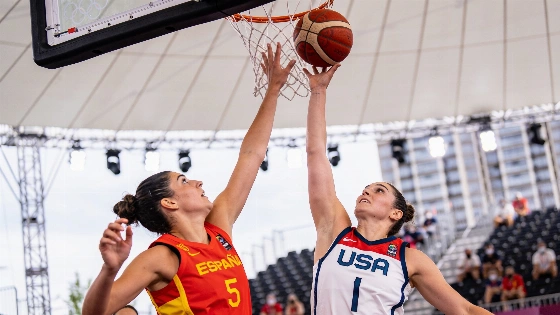
Detailed statistics from the Spain and United States basketball teams expose clear differences in player performance. Minutes played, points, rebounds, and assists reveal which athletes made the biggest impact. The numbers tell a story of contrasting team strategies.
The latest Spain versus United States women's basketball semifinal offered a clear look at how each team approaches the game, both in terms of player rotation and reliance on individual talent. The stats go beyond just points and rebounds—they show the different philosophies behind each lineup.
Spain, with players like Awa Fam, Maite Cazorla, and Raquel Carrera, spread minutes and responsibilities across the roster. No one player dominated, but several contributed steadily in points, rebounds, and assists. The United States, on the other hand, leaned on its stars. Jackie Young, Breanna Stewart, and Kahleah Copper posted bigger numbers and played longer stretches. According to FIBA, the U.S. beat Spain 76–66 in the 2026 FIBA Women's World Cup semifinal on September 12 in Berlin, earning a spot in the final against France.
The largest run in the game was an 11:0 streak, as confirmed by the official FIBA report.
Rotation patterns made a difference. Spain rotated more often, with most players seeing moderate minutes. The U.S. kept its core group on the floor longer, giving them more chances to score and create plays. This shaped the pace and flow of the game. After a 58:58 tie at the start of the fourth quarter, the U.S. pulled away with an 18:8 run, breaking open what had been a close contest. Both ESPN and FIBA's official stats confirm this late surge.
The numbers cover every major category: rebounds, assists, fouls, steals, turnovers, free throws, three-point shots, and overall player efficiency. Spain's stats point to a team-first approach, with several players making solid contributions but none standing out far above the rest. The U.S. saw its top players lead in scoring and efficiency. Breanna Stewart finished with 17 points, 6 rebounds, 1 steal, and 1 block. Kahleah Copper added 13 points. For Spain, Iyana Martin and Maria Conde each scored 17, showing a more even distribution of offense.
These stats reflect coaching choices. Spain's balanced style can make the team more adaptable, but it may limit big individual performances. The U.S. gets immediate impact from its stars, but heavy minutes can lead to fatigue and make the team easier to scout if rotations stay tight. FIBA's summary shows the U.S. held small but important leads in several areas: 40% field goal shooting to Spain's 38%, 50% on two-pointers to Spain's 47.5%, 35 rebounds to 27, and 19 assists to 14. Spain, meanwhile, shot 90.9% from the free-throw line, well ahead of the U.S.'s 77.1%.
Caitlin Clark, one of the most talked-about U.S. players, had a quiet game with just 1 point, 1 assist, 1 rebound, and 1 steal in 16 minutes and 50 seconds of play, underscoring the depth and rotation strategy of the American squad.
These differences are more than just numbers. They shape how teams prepare, adjust, and respond during games. For fans and analysts, the stats offer a window into each team's identity and approach.
In the end, Spain continues to rely on depth and teamwork, while the United States puts its trust in top-tier talent. Both strategies have worked on the world stage, but the latest stats suggest the gap is closing. As international competition gets tougher, teams that don't adapt—whether by spreading the load or letting stars take over—could find themselves left behind. The numbers from this game are more than a record; they're a sign of where the sport is heading.