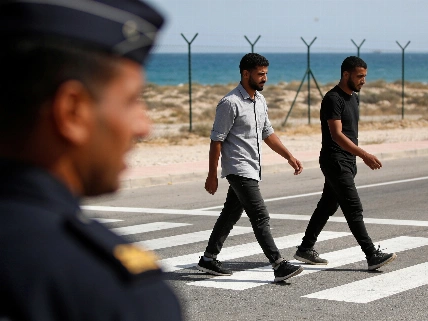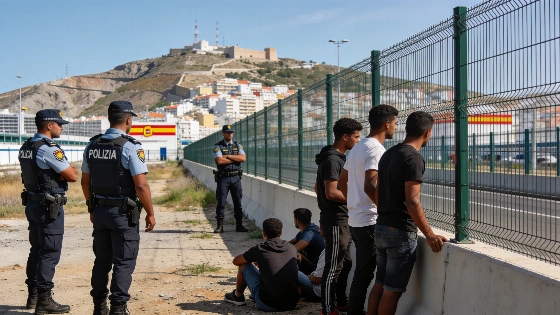
Foreign Minister Albares has ruled out any migrant transfers to mainland Spain after the mass entry in Ceuta. He insists all irregular arrivals will be returned to Morocco, with Rabat's cooperation.
Spain's Foreign Minister, José Manuel Albares, has firmly stated that no migrants who entered Ceuta irregularly have reached the Spanish mainland. Speaking from Ceuta after meeting with the city's president, Albares emphasized that every person who crossed the border illegally will be sent back to Morocco, reflecting what he described as Rabat's explicit commitment to repatriation.
The announcement follows the unprecedented influx of over 70,000 people from Morocco into Ceuta during just two days at the end of July. Albares described Ceuta's border as the most complex in both Spain and Europe, but assured that the integrity of the Schengen Area remains fully protected in both Ceuta and Melilla. He also stressed that no one has left Ceuta for the peninsula, nor will they be able to do so, addressing concerns among Spanish and European authorities about secondary movements.
While Albares was clear about the government's intention to return all irregular entrants, he did not specify a timeline for these deportations. He acknowledged that Spanish law and judicial rulings must be respected, but insisted that restoring normality in Ceuta and ensuring the swift return of minors are top priorities. Daily discussions with Moroccan Foreign Minister Naser Burita are ongoing, and Albares highlighted Morocco's full willingness to cooperate on returns.
The Spanish government is working on several fronts: accelerating the removal of those still in Ceuta, reinforcing border controls, deepening cooperation with Morocco, and seeking greater involvement from the European Union in Ceuta's future. Albares noted that Morocco has not demanded any concessions in exchange for accepting its citizens back, and pointed out that the rapid return of thousands was possible only because of Rabat's cooperation—a situation that often complicates similar crises elsewhere.
According to official figures, 72,000 people entered Spain irregularly via Ceuta, with 70,000 returning to Morocco in the days that followed. Albares credited effective diplomatic communication for this outcome and said both countries will jointly review how to prevent similar incidents, including the role of social media in mobilizing large groups toward the border. He described Morocco as a crucial partner in this context.
The minister's statements have quickly circulated among migrants in Ceuta, many of whom now fear imminent deportation. Initial uncertainty among minors about Morocco's willingness to accept them has given way to anxiety, as the Spanish government's determination and Rabat's cooperation become clear. Albares also addressed those still in Morocco or elsewhere in Africa, warning against risking their lives and resources on attempts to enter Ceuta or Melilla, as all irregular entrants will be returned and will not reach the peninsula or Europe.
On the diplomatic front, Albares contrasted Spain's approach with that of Italy, noting that Spain has the lowest number of irregular arrivals among Mediterranean EU states, while Italy faces the highest. He criticized the Italian government's lack of solidarity during the Ceuta crisis, suggesting its stance may be driven by domestic political interests rather than European unity. This echoes recent tensions over extradition cases, such as the high-profile situation involving a US activist in Ibiza, which has also drawn attention to Spain's handling of international legal and migration issues—see the detailed coverage on Spain's extradition decisions in politically sensitive cases.
Ceuta and Melilla, Spain's two North African enclaves, have long been focal points for migration pressure due to their land borders with Morocco. The Schengen Area, which allows passport-free travel across much of Europe, does not automatically extend to these territories, making border management a persistent challenge. The recent crisis has intensified calls for a coordinated EU response and highlighted the importance of bilateral cooperation with Morocco. As Spain moves to restore order in Ceuta, the government faces ongoing scrutiny over its handling of returns, legal safeguards for minors, and the broader implications for European migration policy.